Tuesday, February 17, 2009
I've moved....in all senses
Well folks, I've moved from Chile to California. I've also moved to a blog that isn't about Valparaiso. Keep stopping in here. Thanks for tuning in to one of the best, worst, and most colorful years of my life. Hopefully it just keeps getting stranger and more beautiful.


Thursday, January 22, 2009
Meredith's Best Of Valpo
Well, everyone, my transitional state has me in an overly introspective mood as of late. Then, when I'm not being pensive, I'm running around trying to visit everyone I know in a 4 or 5 state area (not as bad as it sounds, I'm from New England), and both unpacking from Chile and re-packing for California.....which involves going through many storage boxes. All this combined leads to a substantial lack of interest in posting on the blog. I refer you to my previously flawless record of regular posting and thank you for your patience as I get my life rearranged.
In the meantime, I present to you: Meredith's Official Best of Valparaiso, Chile!
Food and Drink
Best budget dinner restaurant: Epif, international-style vegetarian food on Cerro Alegre
Best pricey dinner restaurant: Concepcion, cuisine nouveau, Calle Papudo on, you guessed it, Cerro Concepcion. Sit outside in the garden in the summer.
Best dinner with a view: Cafe Turri, Cerro Concepcion. Reserve a specific table for a good view, and don't forget to order the house cocktail, it's incredible.
Best lunch, full menu: Natur-In, Calle Condell, near Plaza O'Higgins (walk up Uruguay and take a right, it'll be on your left, big wooden door). Vegetarian, three course menu for 1,200, coming in at 2,000 if you order one of their delicious fresh juices (recommended).
Best quick & cheap lunch (and dinner): El Sandwich Cubano, Plaza Intendencia (kitty-corner from Lider). Get the Moros y Cristianos plate, it's the best thing on the menu and also the best deal.
Best (in that it is the only) place to eat on a Sunday: Allegretto, good pizzas and drafts, open late.
Best seafood: Any of the small shops near the fish market in the port.
Best sushi: Kookai, Plaza Victoria--actually owned by Japanese people, and graced by this sign:

Best salad: Mora, a bit down from El Sandwich Cubano in the direction of Lider.
Best ice-cream: The stand in the front section of the wood-facade restaurant in Plaza Anibal Pinto.
Best fruit wine: No, not sangria--fruit blended with wine. Tie between Barposeia and Ritual, side by side on Almironte Montt by Plaza Anibal Pinto.
Best tea menu: Cafe con Letras, Almironte Montt, Cerro Alegre.
Best coffee: Puro Cafe, Plaza Victoria. Just watch out: they claim to have wireless, but it never works.
Best scary, knock-you-down drink: El Suicidio, Pub Matiz, which oddly enough has two locations directly opposite one another on Subida Ecuador.
Best place to get a beer in the afternoon: "The Place With The Mean Waitresses," as dubbed by Elisa and myself: walk up Bellavista towards Subida Ecuador. It's on your left with a typical Fuente de Soda menu. You'll recognize it by a neon sign on the back wall that says "Chiloe," two TVs that are never playing the same thing, a jukebox, and a whole lot of old men lounging around with liters and cigarettes. Not recommended as a solo venture, but two drinking girls can have a nice time chatting and disrupting social conventions. Don't forget to order a liter each.
Nightlife
Best free evening (indoor) entertainment: Wednesday and Thursday nights at Boliche, Calle Cummings (as of my last residency, a great band and a comedy musical performance, respectively)
Best paid evening entertainment: Events at Teatro Mauri, Avenida Alemania
Best cultural events: Programming at La Sebastiana, Cerro Bellavista
Best club: La Sala, Port District, just ask someone for directions. I don't go to clubs unless I'm drunk enough to dance, which also means too drunk to pay attention to where exactly I am.
Best cafe-style bar: Pajaritos, Calle Donoso.
Best movie house: Cine Insomnia, Calle Condell
Best combo deal: Combo 1 at Coyote Quemado, Subida Ecuador: 1 taco, 1 shot of tequila, and 1 beer for 1 mil.
Best place for a cheap vodka: Abasto, Calle Cummings, next to the Ascensor La Reina. Don't let the 800 teenage fleites hanging out on the Ascensor's steps put you off, just wade through them and head on in, the bar's got a bouncer.
Best place for a terremoto: Bitacura, Calle Cummings, serves up a large and inexpensive pitcher of this pineapple-ice cream-alcohol concoction.
Best place for an expensive cocktail: El Trole, Calle Cummings, where you can sit in an old trolley and enjoy a nice atmosphere. Completely empty until at least 12:30.
Best bet for a late night snack: Otra Cosa, Almirante Montt, at Plaza Anibal Pinto. They always seem to be open and have dozens of different kinds of empanadas, some vegetarian, as well as completos and other such things.
Best live music: Wander around the Port district and you'll find lots of shows.
Best over-all entertainment: The festivals!
Best advice:Don't walk up stairway pasajes at night!
Tourist Jaunts
Best quirky spot to visit: Cemeterio Playa Ancha, with its hand-constructed budget pseudo-mausoleums. Don't miss the grave of Emile Dubois, Valpo's own unofficial saint, in the uphill right corner in the home-made section of the cemetary.
Best real-neighborhood walking tour: Cerros Polanco and Baron
Best cultural walking tour: Up and around Cerros Alegre and Concepcion, and don't forget the passageways. Then head up Almironte Montt to the circular shaped square and take a left onto Avenida Alemania. Enjoy the views and the various monuments as you make your way to Cerro Bellavista. Turn left on Calle Florida and visit Pablo Neruda's house, La Sebastiana. Head down Cerro Bellavista, keeping to the right of the church, and wander the not-spectacular but satisfactory Museo a Cielo Abierto. Head down Ascensor Espiritu Santo, turn left on Calle Condell and visit the oh-so-strange museum of natural history.
Best day trip: Hiking Cerro La Campana (accesible by public transit)
Best near-by camping: Laguna Verde--neither a Laguna, nor Verde, but a great secluded beach. Catch a bus in front of Lider heading south, go past the actual town of Laguna Verde (ask the driver to let you off on the road to the lighthouse). ASK FOR DIRECTIONS when you get there on how to get to the beach, and don't trust small children (see linked post).
Best beach: I prefer the third beach north in Vina.
Best thing to do on a Sunday: Check out the antique/flea market in Plaza O'Higgins.
Best views of the city: Cerros Artilleria and Baron.
Goods and Services
Best laundry for the best price: Jerusalem, Plaza Anibal Pinto, middle portico in the large ugly gray building.
Best place to use Skype: Cerro @legre, Calle Urriola. Good connection, good headsets, and best of all, quiet--no gamers.
Best place to sit for hours using wireless, having ordered only one cup of tea: Desayunador, Cerro Alegre, Almironte Montt on the corner of Urriola. The wait staff is hard to flag down, but they also won't bother you even if you're there for 6 hours. Even better, all the booths are next to outlets and no one minds if you plug in.
Best used clothing: Calle Condell, on the right heading into the pedestrian portion of Subida Equador. Unsure of the name, but you'll see the racks of clothes. There's some decent stuff in there, particularly if you're heading to a theme party.
Best new clothing: Unfortunately, you'll have to head to the---ugh---mall in Vina if you need something nice. Take a bus marked Libertad and get off at 18 Norte, you'll see it. If you have the time, sometimes decent things can be found in Ripley (Plaza Victoria) or Polar (Avenida Argentina), and they'll be much cheaper than the mall.
Best multi-lingual bookstore: At the very bottom of Calle Cummings, at the corner with Plaza Anibal Pinto.
Best kept financial secret: Banks close at 2pm, but you can also cash checks from many Chilean banks at ServiPag (best office is in the financial district, ask which street as I can't recall).
Best place for cheap produce: The market house, near the end of Avenida Brasil, and the Saturday markets on Avenida Argentina and in the port.
Best place to buy fish: The fish market in the port. There is no fish, repeat no fish, in the supermarket (Lider).
Best place to buy anything under the sun, for cheap: Avenida Argentina, Saturdays and Sundays.
Best place to buy cheap bags and luggage: Walking from Plaza Victoria towards the Terminal de Bus on Pedro Montt, a few blocks up on the left side, is a place with medium sized backpacks for 2mil, small suitcases for 4, etc.
Best deal on a bus to Argentina: Cata, cleverly hidden on the second floor of the Terminal de Bus.
Best place to rent a car: Walk along Calle Independencia near Plaza O'Higgins, there are several rental places. An economy car can be rented for 16.000 a day.
Best way to find an apartment: Walk around the neighborhood and look for signs in the windows; avoid rental agencies.
In the meantime, I present to you: Meredith's Official Best of Valparaiso, Chile!
Food and Drink
Best budget dinner restaurant: Epif, international-style vegetarian food on Cerro Alegre
Best pricey dinner restaurant: Concepcion, cuisine nouveau, Calle Papudo on, you guessed it, Cerro Concepcion. Sit outside in the garden in the summer.
Best dinner with a view: Cafe Turri, Cerro Concepcion. Reserve a specific table for a good view, and don't forget to order the house cocktail, it's incredible.
Best lunch, full menu: Natur-In, Calle Condell, near Plaza O'Higgins (walk up Uruguay and take a right, it'll be on your left, big wooden door). Vegetarian, three course menu for 1,200, coming in at 2,000 if you order one of their delicious fresh juices (recommended).
Best quick & cheap lunch (and dinner): El Sandwich Cubano, Plaza Intendencia (kitty-corner from Lider). Get the Moros y Cristianos plate, it's the best thing on the menu and also the best deal.
Best (in that it is the only) place to eat on a Sunday: Allegretto, good pizzas and drafts, open late.
Best seafood: Any of the small shops near the fish market in the port.
Best sushi: Kookai, Plaza Victoria--actually owned by Japanese people, and graced by this sign:
Best salad: Mora, a bit down from El Sandwich Cubano in the direction of Lider.
Best ice-cream: The stand in the front section of the wood-facade restaurant in Plaza Anibal Pinto.
Best fruit wine: No, not sangria--fruit blended with wine. Tie between Barposeia and Ritual, side by side on Almironte Montt by Plaza Anibal Pinto.
Best tea menu: Cafe con Letras, Almironte Montt, Cerro Alegre.
Best coffee: Puro Cafe, Plaza Victoria. Just watch out: they claim to have wireless, but it never works.
Best scary, knock-you-down drink: El Suicidio, Pub Matiz, which oddly enough has two locations directly opposite one another on Subida Ecuador.
Best place to get a beer in the afternoon: "The Place With The Mean Waitresses," as dubbed by Elisa and myself: walk up Bellavista towards Subida Ecuador. It's on your left with a typical Fuente de Soda menu. You'll recognize it by a neon sign on the back wall that says "Chiloe," two TVs that are never playing the same thing, a jukebox, and a whole lot of old men lounging around with liters and cigarettes. Not recommended as a solo venture, but two drinking girls can have a nice time chatting and disrupting social conventions. Don't forget to order a liter each.
Nightlife
Best free evening (indoor) entertainment: Wednesday and Thursday nights at Boliche, Calle Cummings (as of my last residency, a great band and a comedy musical performance, respectively)
Best paid evening entertainment: Events at Teatro Mauri, Avenida Alemania
Best cultural events: Programming at La Sebastiana, Cerro Bellavista
Best club: La Sala, Port District, just ask someone for directions. I don't go to clubs unless I'm drunk enough to dance, which also means too drunk to pay attention to where exactly I am.
Best cafe-style bar: Pajaritos, Calle Donoso.
Best movie house: Cine Insomnia, Calle Condell
Best combo deal: Combo 1 at Coyote Quemado, Subida Ecuador: 1 taco, 1 shot of tequila, and 1 beer for 1 mil.
Best place for a cheap vodka: Abasto, Calle Cummings, next to the Ascensor La Reina. Don't let the 800 teenage fleites hanging out on the Ascensor's steps put you off, just wade through them and head on in, the bar's got a bouncer.
Best place for a terremoto: Bitacura, Calle Cummings, serves up a large and inexpensive pitcher of this pineapple-ice cream-alcohol concoction.
Best place for an expensive cocktail: El Trole, Calle Cummings, where you can sit in an old trolley and enjoy a nice atmosphere. Completely empty until at least 12:30.
Best bet for a late night snack: Otra Cosa, Almirante Montt, at Plaza Anibal Pinto. They always seem to be open and have dozens of different kinds of empanadas, some vegetarian, as well as completos and other such things.
Best live music: Wander around the Port district and you'll find lots of shows.
Best over-all entertainment: The festivals!
Best advice:Don't walk up stairway pasajes at night!
Tourist Jaunts
Best quirky spot to visit: Cemeterio Playa Ancha, with its hand-constructed budget pseudo-mausoleums. Don't miss the grave of Emile Dubois, Valpo's own unofficial saint, in the uphill right corner in the home-made section of the cemetary.
Best real-neighborhood walking tour: Cerros Polanco and Baron
Best cultural walking tour: Up and around Cerros Alegre and Concepcion, and don't forget the passageways. Then head up Almironte Montt to the circular shaped square and take a left onto Avenida Alemania. Enjoy the views and the various monuments as you make your way to Cerro Bellavista. Turn left on Calle Florida and visit Pablo Neruda's house, La Sebastiana. Head down Cerro Bellavista, keeping to the right of the church, and wander the not-spectacular but satisfactory Museo a Cielo Abierto. Head down Ascensor Espiritu Santo, turn left on Calle Condell and visit the oh-so-strange museum of natural history.
Best day trip: Hiking Cerro La Campana (accesible by public transit)
Best near-by camping: Laguna Verde--neither a Laguna, nor Verde, but a great secluded beach. Catch a bus in front of Lider heading south, go past the actual town of Laguna Verde (ask the driver to let you off on the road to the lighthouse). ASK FOR DIRECTIONS when you get there on how to get to the beach, and don't trust small children (see linked post).
Best beach: I prefer the third beach north in Vina.
Best thing to do on a Sunday: Check out the antique/flea market in Plaza O'Higgins.
Best views of the city: Cerros Artilleria and Baron.
Goods and Services
Best laundry for the best price: Jerusalem, Plaza Anibal Pinto, middle portico in the large ugly gray building.
Best place to use Skype: Cerro @legre, Calle Urriola. Good connection, good headsets, and best of all, quiet--no gamers.
Best place to sit for hours using wireless, having ordered only one cup of tea: Desayunador, Cerro Alegre, Almironte Montt on the corner of Urriola. The wait staff is hard to flag down, but they also won't bother you even if you're there for 6 hours. Even better, all the booths are next to outlets and no one minds if you plug in.
Best used clothing: Calle Condell, on the right heading into the pedestrian portion of Subida Equador. Unsure of the name, but you'll see the racks of clothes. There's some decent stuff in there, particularly if you're heading to a theme party.
Best new clothing: Unfortunately, you'll have to head to the---ugh---mall in Vina if you need something nice. Take a bus marked Libertad and get off at 18 Norte, you'll see it. If you have the time, sometimes decent things can be found in Ripley (Plaza Victoria) or Polar (Avenida Argentina), and they'll be much cheaper than the mall.
Best multi-lingual bookstore: At the very bottom of Calle Cummings, at the corner with Plaza Anibal Pinto.
Best kept financial secret: Banks close at 2pm, but you can also cash checks from many Chilean banks at ServiPag (best office is in the financial district, ask which street as I can't recall).
Best place for cheap produce: The market house, near the end of Avenida Brasil, and the Saturday markets on Avenida Argentina and in the port.
Best place to buy fish: The fish market in the port. There is no fish, repeat no fish, in the supermarket (Lider).
Best place to buy anything under the sun, for cheap: Avenida Argentina, Saturdays and Sundays.
Best place to buy cheap bags and luggage: Walking from Plaza Victoria towards the Terminal de Bus on Pedro Montt, a few blocks up on the left side, is a place with medium sized backpacks for 2mil, small suitcases for 4, etc.
Best deal on a bus to Argentina: Cata, cleverly hidden on the second floor of the Terminal de Bus.
Best place to rent a car: Walk along Calle Independencia near Plaza O'Higgins, there are several rental places. An economy car can be rented for 16.000 a day.
Best way to find an apartment: Walk around the neighborhood and look for signs in the windows; avoid rental agencies.
Thursday, January 15, 2009
Exit Stage Left
In Pucon, in the Southern region of Los Lagos, the main attraction is Volcan Villarica. This semi-active volcano looms over the town. Elisa being the jock that she is, the first thing that she wanted to do when we arrived was to climb it.
We signed up with one of the many available tour companies, and at 7am Wednesday morning we were bumping our way up the gravel road towards the volcano in the company of four hyperactive guides. They shared massive sandwiches, blasted the radio, and swigged soda from the bottle. I stared at the volcano dominating the windshield and resolved to reach the top.
With large packs filled with mountaineering outfits and one icepick each, we started off at the base. The first section was loose volcanic ash and stone--it was very similar to walking up a vertical beach. The sun was strong and punishing, but we wove our way upwards single file. Elisa, predictably, was at the front of the line, and I was just behind her. The pace was slow and steady, and as my calf muscles began to scream I repeated meditation mantras in my head. In this way we arrived at our first resting place.
From there, we entered the snow. We were given a brief tutorial on proper icepick usage, and off we went. My legs felt fine after the break, and the cardiovascular effort was minimal due to the slow pace. Strangely though, as we wound back and forth over the incredibly steep slope, my head began to feel odd. For about ten minutes, it worsened steadily until I became concerned about my ability to continue.
"Elisa, I'm dizzy."
"It's probably the altitude," she told me. "Take deep breaths."
Ah. I can deal with this. I tried to breath deeply, a difficult task while climbing a mountain. Nonetheless, the feeling only continued. Staring at my feet, as was necessary in order not to miss the footholds cut into the snow, I began to lose sense of which direction was which. At times, my stomach turned and I worried that I would be sick all over the bright white slope. My legs felt shaky, even though they weren't exceptionally tired.
"I don't feel very good."
"You should tell them."
"No!"
I kept pushing. The feeling kept growing. Every five or six minutes I'd ejaculate some increasingly dramatic comment on my condition. At one point, I moaned,
"I feel really, really bad right now!"
The guide heard me and swivelled his head around to face me. "Are you ok?"
"Oh yes!" I said brightly. "I'm fine, I'm fine."
About ten minutes later, some 30 or 40 minutes after I'd begun to feel ill, I was distinctly not fine. I caught my breath a bit too shortly and with that, I lost control over my breathing and began to hyperventilate. My knees gave out and I crashed down onto the snow. The guides ran over and, despite my embarassment, I let my pulse be taken and ate the proferred chocolate. Soon, I was able to make the very short distance to the next resting area, a bare rock in the snow.
Altitude sickness, the guides decided, and refused to let me go higher. And so I stayed on the rock, with a wonderful French woman who had tired, and a young guide who was thrilled to get off easy on his 9th straight day of work. The view was beautiful, and we talked and shared sandwiches before sledding down to the bottom and relaxing in the sun. It was a beautiful day; my two new companions each had wonderful stories to tell; the sun was warm; and the lower down on the mountain we got the more I felt my brain begin to stop spinning and my head stop floating above my body. It was not what I set out to do, but I was happy, and I felt no regrets even while browsing Elisa's pictures of the crater over dinner.
The next morning, I woke up, and I knew that I would leave Chile if I were offered the job I had interviewed for in the States.
It's not the country, though I thought that at first, nor is it being far from home. It's a combination of factors, and at the center is my dissatisfaction with work. Teaching was challenging me, but not in the right ways. I felt that my emotional life was wrought with stress, but that my intellectual life had somehow stagnated. I loved my city and my friends, but I had nothing of my own, no project to put my energy towards.
And so it was that when I left Valparaiso on the morning bus to Buenos Aires last week, I left for good, at least for now.
What next? I'm thrilled to have accepted a full-time volunteer position with couchsurfing.com. I'll be starting as their Member Communications Coordinator and Writer next month. In exchange for my work, I'll receive housing, food, and transportation in Berkeley, CA. If you're not familiar with the project, I encourage you to check it out--it's an incredible effort to transform the way people travel, and one that I've been active in during my time in Valpo.
I don't think that I'm through with Chile, in many ways, so stay tuned as I plan on blogging here for a bit longer. I don't expect to write with the same frequency, giving the changes I'm going through, but I still have plenty to say about my time in Valparaiso. Meanwhile, I'll hopefully have another blog up and running sometime after I arrive in California.
In the end, it sometimes works out that the goals that we set for ourselves need to be changed. Sometimes you need to accept your own limitations, and understand that moving forward will bring you more trouble than glory. Sometimes you need to stop and say, "The view is fine from here."
We signed up with one of the many available tour companies, and at 7am Wednesday morning we were bumping our way up the gravel road towards the volcano in the company of four hyperactive guides. They shared massive sandwiches, blasted the radio, and swigged soda from the bottle. I stared at the volcano dominating the windshield and resolved to reach the top.
With large packs filled with mountaineering outfits and one icepick each, we started off at the base. The first section was loose volcanic ash and stone--it was very similar to walking up a vertical beach. The sun was strong and punishing, but we wove our way upwards single file. Elisa, predictably, was at the front of the line, and I was just behind her. The pace was slow and steady, and as my calf muscles began to scream I repeated meditation mantras in my head. In this way we arrived at our first resting place.
From there, we entered the snow. We were given a brief tutorial on proper icepick usage, and off we went. My legs felt fine after the break, and the cardiovascular effort was minimal due to the slow pace. Strangely though, as we wound back and forth over the incredibly steep slope, my head began to feel odd. For about ten minutes, it worsened steadily until I became concerned about my ability to continue.
"Elisa, I'm dizzy."
"It's probably the altitude," she told me. "Take deep breaths."
Ah. I can deal with this. I tried to breath deeply, a difficult task while climbing a mountain. Nonetheless, the feeling only continued. Staring at my feet, as was necessary in order not to miss the footholds cut into the snow, I began to lose sense of which direction was which. At times, my stomach turned and I worried that I would be sick all over the bright white slope. My legs felt shaky, even though they weren't exceptionally tired.
"I don't feel very good."
"You should tell them."
"No!"
I kept pushing. The feeling kept growing. Every five or six minutes I'd ejaculate some increasingly dramatic comment on my condition. At one point, I moaned,
"I feel really, really bad right now!"
The guide heard me and swivelled his head around to face me. "Are you ok?"
"Oh yes!" I said brightly. "I'm fine, I'm fine."
About ten minutes later, some 30 or 40 minutes after I'd begun to feel ill, I was distinctly not fine. I caught my breath a bit too shortly and with that, I lost control over my breathing and began to hyperventilate. My knees gave out and I crashed down onto the snow. The guides ran over and, despite my embarassment, I let my pulse be taken and ate the proferred chocolate. Soon, I was able to make the very short distance to the next resting area, a bare rock in the snow.
Altitude sickness, the guides decided, and refused to let me go higher. And so I stayed on the rock, with a wonderful French woman who had tired, and a young guide who was thrilled to get off easy on his 9th straight day of work. The view was beautiful, and we talked and shared sandwiches before sledding down to the bottom and relaxing in the sun. It was a beautiful day; my two new companions each had wonderful stories to tell; the sun was warm; and the lower down on the mountain we got the more I felt my brain begin to stop spinning and my head stop floating above my body. It was not what I set out to do, but I was happy, and I felt no regrets even while browsing Elisa's pictures of the crater over dinner.
The next morning, I woke up, and I knew that I would leave Chile if I were offered the job I had interviewed for in the States.
It's not the country, though I thought that at first, nor is it being far from home. It's a combination of factors, and at the center is my dissatisfaction with work. Teaching was challenging me, but not in the right ways. I felt that my emotional life was wrought with stress, but that my intellectual life had somehow stagnated. I loved my city and my friends, but I had nothing of my own, no project to put my energy towards.
And so it was that when I left Valparaiso on the morning bus to Buenos Aires last week, I left for good, at least for now.
What next? I'm thrilled to have accepted a full-time volunteer position with couchsurfing.com. I'll be starting as their Member Communications Coordinator and Writer next month. In exchange for my work, I'll receive housing, food, and transportation in Berkeley, CA. If you're not familiar with the project, I encourage you to check it out--it's an incredible effort to transform the way people travel, and one that I've been active in during my time in Valpo.
I don't think that I'm through with Chile, in many ways, so stay tuned as I plan on blogging here for a bit longer. I don't expect to write with the same frequency, giving the changes I'm going through, but I still have plenty to say about my time in Valparaiso. Meanwhile, I'll hopefully have another blog up and running sometime after I arrive in California.
In the end, it sometimes works out that the goals that we set for ourselves need to be changed. Sometimes you need to accept your own limitations, and understand that moving forward will bring you more trouble than glory. Sometimes you need to stop and say, "The view is fine from here."
Tuesday, December 9, 2008
Sheaves of wheat and dioramas
This past weekend, the Virgin Mary intervened directly in my life (albeit indirectly) and kept me in Santiago for two days longer than intended.
I am referring to December 8th, Catholocism's day to recognize the Immaculate Conception. All across Latin America, different countries take a different spin on the eigth. In Columbia, candles are lit simultaneously in all (participating) houses, representing light of Christ and also solidarity amongst families and neighbors. In Mexico, the day blends with the Saint Day of Juan Diego Cuauhtlatoatzin, an indigenous Mexican canonized in 2002 for being the witness of the apparition of Nuestra Senora de Guadalupe, who is celebrated herself later this week on the 12th. Worshippers also turn out to visit the Virgen de Juquila, in Oaxaca, pledging various numbers of future visits in return for favors and miracles. In Paraguay, the faithful make their way to see the Virgen de Caacupé, a sculpture of Mary made in the 1800s. The legend holds that the artist was wandering outside the city, looking for suitable materials for his work, when he was surrounded by a hostile tribe from the area. He promised to create a statue in honor of the Virgen if she would save his life, and upon emerging from the situation without harm, immediately did so.
In Chile, or at least in the Central Valley, there are two main celebrations on December 8th. The first is far more famous and is the culprit behind my long weekend. Each year, Route 68, which connects Santiago to Valparaiso, is closed for the majority of its distance to make room for several hundred thousand pilgrims who make the 60-kilometers or so walk from Santiago to the temple of La Virgen de Lo Vasquez. The temple is located just outside the small town of Casablanca, about 30 kilometers south-east of Valparaiso. This pilgrimage attracts yearly media coverage, as it is a popular show of penance amongst the most deliriously devoted to crawl the last few kilometers along the concrete to the shrine.
The other celebration takes place within Santiago, in the Quinta Normal area. This is where the impressively large Santuario de Lourdes, officially designated as a "minor basilica," maintains a forceful if not exactly graceful posture over the surrounding residential neighborhood. Across from the church's entrance, a man-made grotto holds images of the Virgen, and a near-by fountain pumps out holy water by the gallon.
Riding the bus to Santiago on Saturday, pilgirms were already in evidence along the road. One young couple waved at the bus and pumped a Chilean flag with a surface area close to that of my dining room table. Families had set up tents and were lounging after hours on the road. Small children swam and played in the trickle of a river that runs alongside the road, in the midst of horses grazing and plastic bags floating along. At the turn off for the Sanctuary, every available spot on the grass was already filled with tents and vendors' collapsible stalls. I began to see that my return was going to be more complicated than I thought. On my arrival, I confirmed it: I could get back, but it was going to take several hours due to the road closure.
After an interesting and enjoyable Santiago weekend, I awoke on Monday determined to make it to Lo Vasquez. First, though, I needed to eat. I had taken a room near La Moneda, so I wandered into the pedestrian streets near Plaza de Armas. Normally packed with people shopping and eating, even performing illegal lip-syncing shows, the streets were filled with one shuttered store after another. Interestingly enough, while going to the mall or stopping in at a restaurant are apparently not appropriate activities for a holy day, major stores Paris and Ripley seem convinced that the Virgin won't take offense if you stop in at their electronic branches to pick up a new TV. It also seems that completos and other fast food are the preferred nutrition for such a day.
I began to get a little bit desperate for some sort of food with at least a minor vitamin content when I had a flash of inspiration. Where, in the United States, is it always possible to eat on Christmas? Chinese food! I rushed off to one that I knew of and was happily enjoying a veggie chop suey within half an hour.
Following this (and an ice cream, and a lounge in the Parque Forestal--I'm not Catholic, after all, and I expect a bit of relaxation from my days off no matter what the cause) I took the metro out to Quinto Normal. After asking around, it had become apparent that if I wanted to go to Lo Vasquez from Santiago, I was going to have to walk it. My curiousity was not that strong, so at the end of the metro line I walked through the park and arrived on Calle Lourdes.
The scene was not what I expected. All along the street, people had set up tents and camper vans, as in Casablanca. These were not pilgrims, however; they were vendors. And oh what vendors--used clothing, cosmetics in bulk, cheaply made shoes, antique or simply worn down knick-knacks, it was all there. In fact, it was not much different from Valparaiso's weekend flea market on Avenida Argentina, where it is guaranteed that any strange missing part from any given appliance can be found if you have enough patience.
Once I entered the church yard, the scene was equally tacky but with a bit more religious flavor. Here, one can obtain a bottle for holy water in the shape of the Virgin Mary, with a screw cap perched oddly on the top of her head. There are also, of course, plastic statues of the lady of all variety of sizes, ranging from dashboard to lawn shrine, in my estimation. The same vendors offered diorama-esque representations of the Virgin appearing in a grotto, with a surprised plastic doll saint gazing upon her in wonder. These were also available in desktop through display case sizes.
One ubiquitous product that seemed a bit more pure of heart was small sheaves of wheat, affixed with a small card with an image of Mary. I approached a man to ask about the significance.
"It's wheat," he answered. I was aware, I told him, but could he tell me what it was used for?
With a helpful but confused look, he explained to me, "Lots of things! Bread, cookies, cakes...."
I cut him off. "What is the religious significance? Why is it being sold today at the church?"
He looked at me for a moment and then shrugged. "No idea," he said amiably.
To be fair, I would imagine that most people buying wheat stalks at a church have some purpose in mind, and are not inclined to ask for directions. In researching after the fact, I found two possibilites. First, wheat, together with grapes, symbolizes the Eucharist since it is used to make the unleavened bread that represents the body of Christ. Secondly, there is a parable from Matthew that equates Christians with wheat (useful, good) and non-believers as weeds (bad, not good for much). At the time of "harvest," i.e. the end of the world, the angels will act as reapers and take the "wheat" off to heaven. Out of the two of these, I'm more inclined to think that the wheat available in Santiago is linked to the second symbol, since the Virgin is meant to represent purity and goodness. In my limited understanding of things, the Eucharist is a purely Christ-based thing and as such seems an odd thing to invoke for a day centered on his mother--unless it's a reference to the Immaculate Conception itself, which I suppose is the initiation of the body of Christ.
Inside the constructed grotto, mass was being said. I watched for a while and then made my way over to the holy water fountain, an oddly automated version of a traditional rite, at least from my perspective.

 Unfortunately, with a dead camera battery, I was unable to capture any more of the scene. Given that I had no baptism to reflect on, as the sign instructed me, I simply stood back and watched as waves of people climbed around on the rock, filling 2 and 3 liter bottles with holy water.
Around the corner, plaques from the contemporary to the distant past record the thanks of visitors whose requests of the Virgin were granted. It is the proper etiquette: if a favor is granted, the worshipper has a responsibility to return and have a stone engraved thanking the saint in question.
I am referring to December 8th, Catholocism's day to recognize the Immaculate Conception. All across Latin America, different countries take a different spin on the eigth. In Columbia, candles are lit simultaneously in all (participating) houses, representing light of Christ and also solidarity amongst families and neighbors. In Mexico, the day blends with the Saint Day of Juan Diego Cuauhtlatoatzin, an indigenous Mexican canonized in 2002 for being the witness of the apparition of Nuestra Senora de Guadalupe, who is celebrated herself later this week on the 12th. Worshippers also turn out to visit the Virgen de Juquila, in Oaxaca, pledging various numbers of future visits in return for favors and miracles. In Paraguay, the faithful make their way to see the Virgen de Caacupé, a sculpture of Mary made in the 1800s. The legend holds that the artist was wandering outside the city, looking for suitable materials for his work, when he was surrounded by a hostile tribe from the area. He promised to create a statue in honor of the Virgen if she would save his life, and upon emerging from the situation without harm, immediately did so.
In Chile, or at least in the Central Valley, there are two main celebrations on December 8th. The first is far more famous and is the culprit behind my long weekend. Each year, Route 68, which connects Santiago to Valparaiso, is closed for the majority of its distance to make room for several hundred thousand pilgrims who make the 60-kilometers or so walk from Santiago to the temple of La Virgen de Lo Vasquez. The temple is located just outside the small town of Casablanca, about 30 kilometers south-east of Valparaiso. This pilgrimage attracts yearly media coverage, as it is a popular show of penance amongst the most deliriously devoted to crawl the last few kilometers along the concrete to the shrine.
The other celebration takes place within Santiago, in the Quinta Normal area. This is where the impressively large Santuario de Lourdes, officially designated as a "minor basilica," maintains a forceful if not exactly graceful posture over the surrounding residential neighborhood. Across from the church's entrance, a man-made grotto holds images of the Virgen, and a near-by fountain pumps out holy water by the gallon.
Riding the bus to Santiago on Saturday, pilgirms were already in evidence along the road. One young couple waved at the bus and pumped a Chilean flag with a surface area close to that of my dining room table. Families had set up tents and were lounging after hours on the road. Small children swam and played in the trickle of a river that runs alongside the road, in the midst of horses grazing and plastic bags floating along. At the turn off for the Sanctuary, every available spot on the grass was already filled with tents and vendors' collapsible stalls. I began to see that my return was going to be more complicated than I thought. On my arrival, I confirmed it: I could get back, but it was going to take several hours due to the road closure.
After an interesting and enjoyable Santiago weekend, I awoke on Monday determined to make it to Lo Vasquez. First, though, I needed to eat. I had taken a room near La Moneda, so I wandered into the pedestrian streets near Plaza de Armas. Normally packed with people shopping and eating, even performing illegal lip-syncing shows, the streets were filled with one shuttered store after another. Interestingly enough, while going to the mall or stopping in at a restaurant are apparently not appropriate activities for a holy day, major stores Paris and Ripley seem convinced that the Virgin won't take offense if you stop in at their electronic branches to pick up a new TV. It also seems that completos and other fast food are the preferred nutrition for such a day.
I began to get a little bit desperate for some sort of food with at least a minor vitamin content when I had a flash of inspiration. Where, in the United States, is it always possible to eat on Christmas? Chinese food! I rushed off to one that I knew of and was happily enjoying a veggie chop suey within half an hour.
Following this (and an ice cream, and a lounge in the Parque Forestal--I'm not Catholic, after all, and I expect a bit of relaxation from my days off no matter what the cause) I took the metro out to Quinto Normal. After asking around, it had become apparent that if I wanted to go to Lo Vasquez from Santiago, I was going to have to walk it. My curiousity was not that strong, so at the end of the metro line I walked through the park and arrived on Calle Lourdes.
The scene was not what I expected. All along the street, people had set up tents and camper vans, as in Casablanca. These were not pilgrims, however; they were vendors. And oh what vendors--used clothing, cosmetics in bulk, cheaply made shoes, antique or simply worn down knick-knacks, it was all there. In fact, it was not much different from Valparaiso's weekend flea market on Avenida Argentina, where it is guaranteed that any strange missing part from any given appliance can be found if you have enough patience.
Once I entered the church yard, the scene was equally tacky but with a bit more religious flavor. Here, one can obtain a bottle for holy water in the shape of the Virgin Mary, with a screw cap perched oddly on the top of her head. There are also, of course, plastic statues of the lady of all variety of sizes, ranging from dashboard to lawn shrine, in my estimation. The same vendors offered diorama-esque representations of the Virgin appearing in a grotto, with a surprised plastic doll saint gazing upon her in wonder. These were also available in desktop through display case sizes.
One ubiquitous product that seemed a bit more pure of heart was small sheaves of wheat, affixed with a small card with an image of Mary. I approached a man to ask about the significance.
"It's wheat," he answered. I was aware, I told him, but could he tell me what it was used for?
With a helpful but confused look, he explained to me, "Lots of things! Bread, cookies, cakes...."
I cut him off. "What is the religious significance? Why is it being sold today at the church?"
He looked at me for a moment and then shrugged. "No idea," he said amiably.
To be fair, I would imagine that most people buying wheat stalks at a church have some purpose in mind, and are not inclined to ask for directions. In researching after the fact, I found two possibilites. First, wheat, together with grapes, symbolizes the Eucharist since it is used to make the unleavened bread that represents the body of Christ. Secondly, there is a parable from Matthew that equates Christians with wheat (useful, good) and non-believers as weeds (bad, not good for much). At the time of "harvest," i.e. the end of the world, the angels will act as reapers and take the "wheat" off to heaven. Out of the two of these, I'm more inclined to think that the wheat available in Santiago is linked to the second symbol, since the Virgin is meant to represent purity and goodness. In my limited understanding of things, the Eucharist is a purely Christ-based thing and as such seems an odd thing to invoke for a day centered on his mother--unless it's a reference to the Immaculate Conception itself, which I suppose is the initiation of the body of Christ.
Inside the constructed grotto, mass was being said. I watched for a while and then made my way over to the holy water fountain, an oddly automated version of a traditional rite, at least from my perspective.

 Unfortunately, with a dead camera battery, I was unable to capture any more of the scene. Given that I had no baptism to reflect on, as the sign instructed me, I simply stood back and watched as waves of people climbed around on the rock, filling 2 and 3 liter bottles with holy water.
Around the corner, plaques from the contemporary to the distant past record the thanks of visitors whose requests of the Virgin were granted. It is the proper etiquette: if a favor is granted, the worshipper has a responsibility to return and have a stone engraved thanking the saint in question.
Everyone that I asked about the two celebrations in Chile told me that the Virgin had appeared both in the grotto at the Sanctuario de Lourdes and at the Templo de Lo Vasquez. I found it a bit strange that this narrow corridor between the capitol and my city could have been so popular with saints of the highest mark. It also seemed too convenient that the Virgin would appear in a manmade grotto--what would they have done with it if she hadn't shown up? Did she appear in a mark of approval for the construction techniques.
A bit of time on the Chilean Catholic church's website sorted things out. In Casablanca, in the mid 19th century, a family by the name of Ulloa erected a shrine to the Virgin in their front yard. People from surrounding areas began to pay their respects on the 8th, and a year or two later the family Leiva Vásquez was instrumenal in moving the figure to a new site. There was a bit of a squabble--apparently the Ulloa family wanted the shrine to remain on their property, but in the end the church authorities blessed the new site.
The real meat of the legend came during the 1906 earthquake, which leveled huge sections of Chile. In Casablanca, when the devoted returned to their shrine to see what had happened, they found that all of the structure had been destroyed except for the wall which held the image of the Virgin. That was that: the site was blessed as an official temple and holy site, and the grand pilgrimages began, growing larger each year.
The site in Santiago is a bit less of a story. Around the same time that the Ulloas were converting their garden into a religious zone, the Virgin Mary was seen in Lourdes, France, in one of the most famous of such events (hinged largely on the fact that she is said to have spoken to witnesses, proclaiming, "I am the Immaculate Conception"). A Chilean priest described on the site as "fervent," one Jacinto Arriagada, decided to honor the event with the construction of the church and grotto of Lourdes, Santiago. The grotto, it turns out, is a representation of the site of the appearance in France.
So it turns out that the Virgin has not shown herself in Chile. In Santiago, one can worship by proxy, and in Lo Vasquez her influence saved her image, or so the logic goes. This does not seem to be widely known, based on my informal surveying, but I doubt that it would have any large impact on the Day of the Virgin if the faithful were disillusioned of their impressions. The odd mix of events that includes popcorn stands, plastic icons, sunglasses and shoes right alongside crawling penitents and effusive offerings of flowers has been a part of the culture of the Central Valley for over 100 years. It is easy, at times, to forget that Chile is a Catholic country. Indeed many of the people I spoke to about the Day of the Virgin referred to the participants as "crazies" or "fundamentalists." Nonetheless, the history of this country is indelibly tied to the church, and that mutual past floats to the surface on days like December 8th.
Saturday, December 6, 2008
Teleton: The event of the season
Chile is not a philanthropic society. I witnessed one aspect of this directly when I began my efforts to put together a volunteer-based event listing and cultural portal with the aim of facilitating tourism in Valparaiso. Several months later, I am still moving forward only inches at a time. The main reason? Finding chilenos who will even consider volunteering. The concept of working for things other than money--for experience, for a greater good--is just not as common here as it is in the United States. People tend to be very excited about my project, right up until they find out that I'm not trying to turn a profit.
This is an understandable result of the very active class divide in Chile. Long amongst the top ten most inequal countries in the world, it's only within the last few years that the gap between rich and poor has improved to the point of making us the fourteenth worst country in the world for wealth distribution. The current minimum wage is 144 thousand pesos a month--less than $300. As you may recall if you've been reading this blog recently, this is a 10% increase from the previous rate that was achieved only through strikes by government workers. It wasn't until the papers stopped being pushed and the trash stopped being collected that this modest hike was able to pass.

It is stated statistically that 10% of the Chilean workforce works for minimum wage. In reality, many more work for even less. The minimum wage, after all, only includes those who are paid a salary. Many people in this country are paid on different schemes. For instance, many construction workers and the omnipresent housekeepers or nanas are paid per job or sometimes per diem. Both groups are horrifically underpaid, generally making 10 thousand pesos or less for a day of work. Garment workers are another hard-hit group, as they are paid per item produced and often face stiff quotas. This leads to a complete disregard for working hours limitations. The same problem causes agricultural workers to log 60 hours a week in the picking fields during harvest time, and 10 to 16 hour days in the packing plants. All of these groups of workers survive on a feast-or-famine income, and have almost no rights. Meanwhile, a group of under fifteen families control nearly all of the country's wealth.
There is a billboard between Valpo and Vina del Mar that is very telling. It reads, (rough translation): I study engineering, but I'm angry that we're not building a more equal Chile. So much is contained in that 'but.' The class gap in Chile goes back to the days where a scarce group of patrons (the ancestors of today's power families) ran large plantations, and the rest of the country worked on them. The resulting mindset places a stiff barrier between SES groups. People simply don't feel obliged to help those less fortunate, because that lack of resources is seen as the result of some inherant inadequacy on the part of the lower class. Wait, you study a prestigious career at a university.....but you want to do something about poor people?! Unthinkable!
It is all of this background that makes the yearly Teleton, and the accompanying national excitement, a truly bizarre event.

Teleton is an organization that provides physical therapy and other aid to disabled children throughout Chile. It is financed by a two day--you guessed it--annual telethon. This is nothing akin to the PBS telethons that I recall from childhood weekends. Teleton is a full fledged extravaganza, and it sweeps the country like a tidal wave.

The actual telethon is a sort of variety show, hosted by the irrepressible Don Francisco. This man holds an odd position in the Chilean pantheon. He is the visionary behind Sabado Gigante, the long running variety show that has dominated latin television since its inception in 1962. The show began in Chile, the native country of Don Francisco (whose actual name is Mario Kreutzberger). It was incredibly popular both here and throughout the Spanish speaking world, and in 1986 the big man took advantage of his success and decamped to Miami, Florida, where he has worked ever since with Univision. This desertion leads many chilenos to claim antipathy towards the demigod of daytime television, but in reality he is treated with the mixture of awe and reverential respect that is given to all chilenos who estabilsh themselves on an international level. He can be found gracing billboards across the country, endorsing any number of products, and of course, he returns every year for the Teleton.
Allie and I decided to do Teleton Chilean style, so we headed to our friend Carla's house to watch the first night with her and her friends. All across the country, friends and families were doing the same: sharing beer marked with the Teleton logo, we sat and watched the program. Nearby, on Muelle Baron, Valparaiso's Teleton party was underway under flashing lights and booming reggaeton. In the studio audience in Santiago, the camera scanned the crowd, revealing an obviously high society mix with President Bachelet in the front row.
The show cycles through various types of presentations. First, a dramatic story about someone whose life has been changed by Teleton, told with all the requisite tearful interviews, violin music, and upbeat visions of life today. A coworker of mine at Duoc was the first story to be featured, and later we also met a small girl in a near-vegetative state and a young man with severely limited use of his arms. In between these segments, Don Francisco and other celebrities put on comedy sketches that I generally failed to follow. Then the screen would cut to a city's Teleton party, where a local host would interview community group leaders about the donations they would raised. Many of these people would launch into a long speech, leading everyone in the living room and many of those on TV to shout "Cuanto! Cuanto!" until the number was divulged. The directors of several large chain stores appeared on the show as well, making the somewhat half-decent promise to donate large sums of money--if a certain number of sales were made the following day.
The next day, the morning news devoted 16 pages to Teleton recap so that all of it could be relived.

In the end, the 2008 Teleton--the 30th event of its kind--raised an incredible 16,589,850,127 pesos. At current exchange rates, that's 24,641,989 US dollars. This is a program that does wonderful rehabilitation work, and it is hope-inspiring to see it receiving such an outpouring of support.
Nonetheless, I found myself looking at the whole thing with somewhat skeptical eyes. "We have incredible solidarity as a nation," one Chilean told me. I'm inclined to disagree. Two days of charity a year is simply not enough in a country with an economic situation like Chile's.
"Teleton has fundamentally changed our society," another told me. I do believe this, and I also hope that in time it can produce even more change. Teleton, with its campy extravaganza, evening dresses, and giant parties, introduced the concept of charity to Chile in a way that had not been done before. I hope that perhaps this phenomenon can spread, so that some day in Chile helping the unfortunate will be a social responsibility, not a weekend of festivities.
Saturday, November 22, 2008
Country mouse goes to the big city
Early last Saturday morning I found myself, bleary eyed from an open-bar wedding reception the night before, adrift in Santiago. If I had not been deprived of my crashing surface, I most likely would have slept another 3 or 4 hours. Nonetheless, I was in the capital and determined to make use of it, as tempting as a nice bus seat sounded.
 It had been months since I'd been in a city, and my traveling companion, the lovely Argentinian Florencia, was so amused by my reaction that she needed to document it.
Returning to last Saturday. I bought myself a gigantic cup of coffee and sat reading my book and eating a croissant. As my hangover cleared a bit, I was able to navigate my way to the counter once again. I purchased a large French press and a pound of ground coffee. If I can dig up my crossword puzzle book from the plane last February, my next day off will be a delight.
It was very strange to be in a North American institution. As is the Starbucks way, everything is standardized, so the store was decked out in Christmas decorations and resounding with carols. Nevermind that Chileans are not overly excited by Christmas, nor can they spell the word in English.

It was strange to be sitting in air-conditioning, wearing a t-shirt, surrounded by red and green ornamentation. My Chilean friends tell me that it is odd even for them, having at this point absorbed much of the northern imagery associated with the holiday. "How bizarre," they tell me, "to have Santa Claus walking around in furs in 80 degree weather!" This will be my first Southern hemisphere Christmas, and I will be missing the snows of Boston.

From Starbucks, I headed to Patronato. The night before, I had advised the mother of an acquaintance that I had this intention. She was accepting, but concerned. "You need to go with only one small purse, and have it all the way up on your shoulder and under your arm."
She also told me not to walk around obliviously, and demonstrated with a duck-footed, wide-eyed pantomime.
As always, I give little creedence to Chilean prophecies of doom. The populace has been inundated with documentaries about the peligro that lurks around every corner, and they have become a country of truly paranoid people. Earlier that same day, a co-worker had told me that she was afraid to go to Santiago, and advised me that the thiefs and robbers that abound there can spot a non-Santaguino from a mile away. One thing that both the acquaintance's mother and my coworker had right was that appearance truly is everything. One thing they've got wrong is the idea that extranjeras don't know how to put off a potential robber.
I grew up in the suburbs of Boston: hardly risky territory. Nonetheless, I have one fierce lady for a mother, and she grew up near the projects in the Bronx. So, despite my tranquilo New England childhood surroundings, I consider myself a trainee in street-smarts from an early age. Two of the most important things that my mother taught me were to always appear confident and to never seem lost. This is why you will be the one to ask for directions if you are ever in my company, because I won't do it. I also won't pause too long at street signs, or consult a map. If I do truly lose my way and absolutely must ask, I do so with a mannerism of "I just can't seem to remember where I put my glasses, silly me." I add to all of these internal rules a permanently irritated and busy expression, a death grip on my bag, and to this day I have yet to be robbed anywhere in the world (despite one or few attempts). I've probably scared off more than a few potential friends but, such is life.
This is how I hit Patronato. The district, particularly on a sunny Saturday, is packed to the point where it mimics the feeling of standing in a long line. This is because the streets are lined with shops and stalls selling mountains of cheap imported clothing.
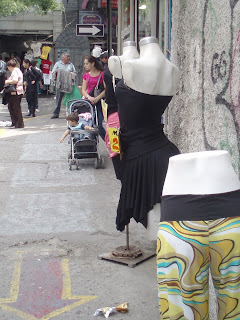


Still somewhat dazed, toting my French press, I slowly shuffled up and down the streets in the molasses-like crowd. After a very short while, I became very uncomfortable, but not from claustrophobia. The climate in my coastal city is very temperate, much like San Francisco in the United States. Its temperatures swing on a very small scale throughout the year, always hovering around a median of about 65 Fahrenheit. Santiago, meanwhile, lies within the valley between the coastal cordillera and the Andes. Sharing the same topography as cities such as Sacramento, it reaches much cooler temperatures in winter, with occasional snow. By the same token, it can be broiling in summer. As spring moves along towards the next season, it is beginning to get toasty in the valley. In my long pants and t-shirt, I found myself uncomfortably over-dressed.

Valparaiso is my heart in Chile. The common expression is "Santiago is Chile," which makes sense: a huge percentage of the population lives there, and nearly all commerce is located there. For me, though, Valparaiso is Chile. I could not imagine leaving my home here and staying in the country. Nonetheless, there are drawbacks to everything. I love my small Chilean city, but it is a small Chilean city. There are things that just can't be found here.
Even Santiago is a little bereft in the museum department, so I decided to skip out on that particular commodity. No, I was out to be a consumer of the first degree. With that in mind, I got off the metro at La Moneda and beelined to Starbucks.
It's an interesting phenomenon. In the US, Starbucks is my enemy: the gobbler of small, beloved coffee shops. For a time in high school, nearly everyone on the staff of one particular Starbucks was a good friend of mine, and we used to throw parties in their back room and basement purely out of spite. Fact of the matter remains, when abroad, Starbucks is the only place where North American-style drip coffee can be found. It seems that the rest of the world thinks it tastes like "sock juice," to quote a French person I spoke to about the matter, or something else of the same degree. I remain resistant to international pressure and I still think with longing about my free days in the States, which always involved the paper, a crossword puzzle, and an entire pot of coffee. So it is that whenever I come across a Starbucks while in another country, it brightens my life just a tad. This can be witnessed by this photo of me, taken in Christchurch, NZ:
 It had been months since I'd been in a city, and my traveling companion, the lovely Argentinian Florencia, was so amused by my reaction that she needed to document it.
Returning to last Saturday. I bought myself a gigantic cup of coffee and sat reading my book and eating a croissant. As my hangover cleared a bit, I was able to navigate my way to the counter once again. I purchased a large French press and a pound of ground coffee. If I can dig up my crossword puzzle book from the plane last February, my next day off will be a delight.
It was very strange to be in a North American institution. As is the Starbucks way, everything is standardized, so the store was decked out in Christmas decorations and resounding with carols. Nevermind that Chileans are not overly excited by Christmas, nor can they spell the word in English.
It was strange to be sitting in air-conditioning, wearing a t-shirt, surrounded by red and green ornamentation. My Chilean friends tell me that it is odd even for them, having at this point absorbed much of the northern imagery associated with the holiday. "How bizarre," they tell me, "to have Santa Claus walking around in furs in 80 degree weather!" This will be my first Southern hemisphere Christmas, and I will be missing the snows of Boston.

From Starbucks, I headed to Patronato. The night before, I had advised the mother of an acquaintance that I had this intention. She was accepting, but concerned. "You need to go with only one small purse, and have it all the way up on your shoulder and under your arm."
She also told me not to walk around obliviously, and demonstrated with a duck-footed, wide-eyed pantomime.
As always, I give little creedence to Chilean prophecies of doom. The populace has been inundated with documentaries about the peligro that lurks around every corner, and they have become a country of truly paranoid people. Earlier that same day, a co-worker had told me that she was afraid to go to Santiago, and advised me that the thiefs and robbers that abound there can spot a non-Santaguino from a mile away. One thing that both the acquaintance's mother and my coworker had right was that appearance truly is everything. One thing they've got wrong is the idea that extranjeras don't know how to put off a potential robber.
I grew up in the suburbs of Boston: hardly risky territory. Nonetheless, I have one fierce lady for a mother, and she grew up near the projects in the Bronx. So, despite my tranquilo New England childhood surroundings, I consider myself a trainee in street-smarts from an early age. Two of the most important things that my mother taught me were to always appear confident and to never seem lost. This is why you will be the one to ask for directions if you are ever in my company, because I won't do it. I also won't pause too long at street signs, or consult a map. If I do truly lose my way and absolutely must ask, I do so with a mannerism of "I just can't seem to remember where I put my glasses, silly me." I add to all of these internal rules a permanently irritated and busy expression, a death grip on my bag, and to this day I have yet to be robbed anywhere in the world (despite one or few attempts). I've probably scared off more than a few potential friends but, such is life.
This is how I hit Patronato. The district, particularly on a sunny Saturday, is packed to the point where it mimics the feeling of standing in a long line. This is because the streets are lined with shops and stalls selling mountains of cheap imported clothing.


Still somewhat dazed, toting my French press, I slowly shuffled up and down the streets in the molasses-like crowd. After a very short while, I became very uncomfortable, but not from claustrophobia. The climate in my coastal city is very temperate, much like San Francisco in the United States. Its temperatures swing on a very small scale throughout the year, always hovering around a median of about 65 Fahrenheit. Santiago, meanwhile, lies within the valley between the coastal cordillera and the Andes. Sharing the same topography as cities such as Sacramento, it reaches much cooler temperatures in winter, with occasional snow. By the same token, it can be broiling in summer. As spring moves along towards the next season, it is beginning to get toasty in the valley. In my long pants and t-shirt, I found myself uncomfortably over-dressed.
Not to worry, this is Patronato. I stopped at the first store that had something cute in the window. Luckily, they had a curtain behind which customers could try on clothes, a luxury in these stores. I entered and put on the sundress I'd chosen. Like all cheap clothing, it required a bit of rearrangement and strap MacGuivering, but five minutes later I left the store 6,000 pesos poorer and infinitely more comfortable, with my coastal clothes stuffed into my shoulder bag.
Other than this, though, I simply couldn't summon the energy necessary for a full Patronato day. Like shopping at a Salvation Army in the US, a successful trip to Patronato requires drive, a discerning eye, and a good amount of time. Last Saturday was not the day for any of this. I was in pursuit of a bigger fish: Missing Ingredients.

Along with its other imports, Barrio Patronato also hosts several well-stocked Korean and Chinese markets. After several wrong turns and yes, even asking for directions, I finally located them. I joyfully texted every living soul I knew in Valpo and picked up a few favors for friends while stocking my own carts. As a cooking enthusiast who favors Asian and Mediteranean foods, there is no shopping spree more delicious than an hour in Asian markets after months and months of supermarkets that consider cheddar cheese too flavorful to stock.
After reaching my limit at about 20 kilos of sauces and spices to carry, I treated myself to the first falafel I've had in months, and then headed wearily but happily to my friend Nereida's house in Providencia. A few pleasant hours later, I was back on the bus, speeding towards Valparaiso at exactly 98 kilometers per hour, as I was advised by the streaming satelite information displayed at the front of every bus.
I could not live in Santiago, I will not lie. It is huge and sprawling; congested; covered in smog; and yes, sometimes dangerous. I would miss my ocean and my seagulls, my hills and my colored houses. Nonetheless, its proximity to Valpo is nothing but a benefit. After months in the regions, even riding the uncomfortably packed metro feels like a refreshing taste of the outside world. It is easy to ensconce oneself in Valpo; the layout of the city almost demands it, clustering the way it does around its enclosed bay. But although I love this town where I meet someone I know at every corner, there is something wonderful and liberating about large cities, where no one knows a thing about you unless you care to inform them. This is a sensation I miss, and one I will seek out more often as I continue to settle here in Chile.
Thursday, November 20, 2008
Minimalism is an art
When I came to Chile, last February, this is what I brought:
 I was pretty happy about my packing. I take pride in traveling light. I'm quite capable of living with very little; in New Zealand I spent 6 months driving around the country with 2 pairs of pants, one shirt of each degree (long sleeved, short sleeved, etc), two pairs of long johns, a scarf, a hat, hiking gear, a sleeping bag, a continually interchanged book and some food.


 I was pretty happy about my packing. I take pride in traveling light. I'm quite capable of living with very little; in New Zealand I spent 6 months driving around the country with 2 pairs of pants, one shirt of each degree (long sleeved, short sleeved, etc), two pairs of long johns, a scarf, a hat, hiking gear, a sleeping bag, a continually interchanged book and some food.
That was a trip of constant movement, however. When you're in one place, it's pretty astonishing the ways that things creep in against your best intentions. Fact of the matter is, I'm a bit of a packrat underneath my minimalist intentions. It's a terrible crush of ideals: I believe in possessing little, but I refuse to waste perfectly good wrapping paper or twist ties or potentially-art-project-usable bus ticket stubs.
I discovered the depth of the situation this past week when my roommate and I switched bedrooms. Our apartment has one decent room and one amazing room, so we've decided on a 2 month rotation for the master bedroom. Now it's my turn, so I packed up my things and moved across the living room. To my astonishment, this is what I discovered:


I have got a lot of stuff.
Over the last few days, I've been organizing myself. Bits of paper flutter down from a stack of documents, asking me, "What would you do if you won the lottery?" and "What would you do if you could have any job you wanted?" "Tell your partner about your family!" an index card instructs me. "Dear Caroline," my handwriting floats across a page, "I've now been in Chile four months...."
I shuffle through a mountain of student worksheets, Spanish-language newspapers I never read, brochures that people stuffed into my hands as I walked down the street, flyers for events that looked interesting but then were forgotten about. Archaeological evidence that I have been living a life here. Debris from the daily back and forth that sometimes slips from the mind next to the enormous decisions that seem to litter the decade of one's twenties.
Holding on to these things is a way of grabbing at time. Renouncing belongings, throwing away brochures, accepting that the letter will never be sent, is accepting the passing of moments. In the end, I seem to be a time-grabber.
Nonetheless, Buddhist principles aside, I went out and bought myself a lovely particle board desk and bookshelf, complete with very small desk chair, and a full length mirror. I'm living here, it's time to accept that I need to make arrangements. So now I am happily writing to you from my newly established, thing-entrenched life. And I didn't throw away the wrapping paper.


Tuesday, November 18, 2008
Sorry folks, the government's closed

About a month ago, I was invited to a small wedding service. In Chile, the matrimonial proceedings are in three parts. I will go into this in another post, but for the moment suffice it to say that the first part is a civil ceremony that legally marries the couple. About a week before the wedding, I asked about dress code.
Casual," I was told, "but I don't really know if they're going to get married or not."
Scandal! I asked for the gossip. It wasn't as juicy as I'd hoped.
"The Registro Civil is on strike, so they might not be able to."
In the end, the ceremony went off as planned, but the strike was not quite finished. Off and on for the last couple of months, goverment workers have been striking for a wage increase. Last week, there was another two week paro: even the operators of the publicly owned ascensores, such as the one by my house, were not working. I had to trudge my way up the hill, but that's the least of the concerns posed by the strike. As of yesterday, it is back on. The effects are wide-reaching--Chile is a country with a large amount of state-run services, and a love of bureaucracy. At the moment, it is impossible to complete any transaction dealing with marriage, divorce, identification papers, visas, death certificates, and even autopsies. Tax services can be accessed only via website. Many public clinics have been shut, and public hospitals are running with emergency staff pulled from other locations. Students at some branches of the public universities can't access any non-academic student services. Valparaiso's port customs office, as that of the airport and all other entry and exit points, is being staffed largely by the armed forces. A large segment of trash collectors also joined in this week.
Yesterday, in the plaza in front of the Intendente, which is the office that represents the executive branch of the federal government within each of the regions, the buildings were shut to the public. Workers waved out of windows from all three government buildings surrounding the plaza. Scraps of shredded newspaper floated down, coating the square, as men in suits tossed armfuls of them out of seventh story windows.


The strike centers on the demand for a universal wage increase of 14.5% for public employees. Original offers from the government were for 4%, then 6%. The current offer is a sliding scale that would award the lowest-paid workers a 9% increase, with decreasing hikes for each subsequent earnings bracket. Those making over 3 million pesos a month, about 4,500 US dollars, would not receive a raise.
This offer seems reasonable, other than the fact that Chile's inflation rate this year has been set at 9.9%. This means that under the current offer, even the lowest paid public employees would not be receiving an adjustment on par with the national economy. Essentially, all of these employees will be making less money than they did last year, in regards to their ability to maintain their living standard. The requested 14.5%, then, is intended to award the workers a 4.6% raise once inflation is factored in. According to the strike's organizers, this amount is a fair reflection of the increase in productivity that is projected for Chile this year.
I know little about finanace, but I will say that it seems entirely reasonable to me that the public employees should be given at the very least a pay raise to compensate for inflation. With the global economic situation, the peso has truly plummeted recently, and it's been felt. You can't hold a conversation with nearly anyone without inflation being mentioned. Part of this is the fact that Chileans love to complain about money; sometimes it seems like a hobby. It is, though a reflection of a very real situation that threatens to alter the quality of life of many people.
On the government's side, I favor the idea of a sliding scale. Offering the same pay raise to all employees makes very little sense and seems unfeasible. Better to pool the money that is available towards those closer to the poverty line rather than to overly augment the lives of those already living comfortably.
On the streets, reactions are mixed. I overheard one woman declaring it absolutely feo that workers in a certain government office hadn't joined the strike. Others stood nearby complaining about the various tasks they would not be able to complete until the strike finished. The effect on the health sector, hardly a shining beacon of efficiency to begin with, is particularly disturbing.
This morning an estimated 4,000 or so people marched through Valparaiso. Protests here are never of the rock-throwing, firehose-spraying, newsworthy variety seen in Santiago, although we do occasionally get some excitement. We do, though, get a huge number of protests, low-key or no, because the National Congress is located here. Today, as I sat at my desk working, the shouts and drumming echoed up from Plaza Sotomayer, where the rally began. Now, all that I can make out is police whistles and the very dull sound of chanting.

Wednesday, November 12, 2008
Sounding the depths

Within the last month or two, strange things have been going on amongst the gringas nearest and dearest to my heart. Some invisible wave of dysfunction is sweeping the cerros. One friend managed to break all of her electronics, and took to random crying fits during nights out on the town. Another announced to me one day that she wanted to open a restaurant in Chile, only to follow this up the next day with the declaration that she intended to leave her boyfriend and move back home--immediately. A third signed up for any activity that seemed vaguely interesting, nearly bought a puppy, and would regularly inform me pleasantly at our meet ups that she'd spent the majority of the preceding day bawling her eyes out.
As for me, well, the list is long. I've developed a habit of spending 3 hours cooking dinner instead of planning a lesson. I've been periodically bed-ridden with severe anxiety over just about anything I can set my mind on. The few belongings that I have in Chile have somehow managed to spread themselves over increasingly large surfaces and in increasingly disorderly ways. I've been coming down with random illnesses and staying up until 5 in the morning more often than not. I've scoured the kitchen and bathroom top to bottom at 3am. My iPod has been stuck on Tegan & Sara--an angst injection if ever there was one. I've embarassed myself at parties by becoming irritated too quickly. I've become sensitive to the point that if someone gives off the slightest vibe of condescension towards me or my Spanish, it's enough to ruin my night. None of the batteries to any of my various electronics are ever charged. My cell phone never has credit. I watched Amadeus the other night (at 3am) and took from it the moral that if Mozart could die insane and unrecognized, it's probably pretty much a sure thing for hit-or-miss EFL teachers. At the moment, I have been accidentally locked into a friend's house with no working telephone (but not to worry, help is on the way)....and instead of appreciating the humor of the situation I have passed the last hour kicking the door and screaming insults into the empty apartment.
What the hell is going on in the Valparaíso outpost of Gringolandia?
If you've lived or studied abroad, you are undoubtedly familiar with this graphic:

Yes, we're talking about culture shock. The conventional wisdom on the topic is illustrated above, showing four stages. In the first stage, the "honeymoon," the new arrival adores every crack in the sidewalk in their new home. In the second, which has many names but is usually simply referred to ominously as Phase 2, the culture shock victim hates the world or, more specifically, the part of it in which they have landed. People here look funny, talk funny, think funny, and everything they do is wrong and unintelligent, the visitor muses. The third stage, the "adjustment" stage, is the process wherein the person thinks, "Gee whiz, I suppose I should be more open-minded and accept that there are good and bad things in both cultures!" And then, ta-dah, our happy global citizen arrives at the much coveted rank of bicultural--stage 4.
This theory is thrown at every North American who wants to leave the country. It's all over the internet. It's in any handbook available at any university Study Abroad office. Somehow, though, in the process of spreading the word about culture shock, we have watered down the concept to the point where it has very little relationship to the actual experience. The actual phenomenon of culture shock is a profound, volatile, and extremely personal experience.
I don't debate the basic foundations of the culture shock theory. All of those occurances do happen at some point within the living abroad experience. It is the lack of complexity that irritates.
For example, I and the people mentioned in the first paragraph arrived in Chile for very diverse reasons, and we lead very different lives here. The thing we have in common, other than the fact that they are my fabulous friends, is that we all stumbled through customs in the Santiago airport approximately nine months ago.
It's far too late for stage 2. I know I at least have seen that attitude come and go ages ago. It was a bit of a low spot, but it was no disaster. The meat of it was: hey, this city's great, but these people can be really annoying. It culminated with a midnight tea drinking session with a long-departed fellow expat in which I declared passionately, "I just don't see how it's possible to work with these people, let alone have relationships with them!"
Don't hate-mail me. I got over it. Chileans are just fine.
This crash that my friends and I are living is not on the clean graph of culture shock, but it is happening with such universality that I can't fail to attribute it to that source. However, if you were to speak to each of us independently about our current discontent, you would probably not make the same connection.
Fact of the matter is, culture shock as a general phenomenon often has very little connection to actual cultural interaction. No one is hating Chile right now. We have our gripes, which we can sometimes overindulge, but at the heart of it no one is roaring on that this is a bad country with bad people. In my case, I'm still very much taken with my city, and completely fascinated by the culture of the people.
The problem is not the difference between the two cultures. This new stage is characterized, in fact, by reaching a level of comfort with the culture. Living here is no longer enough of a challenge to keep my mind fully satisfied. It's certainly still a challenge--stress levels are high. The problem is, it's passed from being a Rubics-cube to being a 1000 piece puzzle of an insipid photograph, if you follow me. It's a drudgery type of challenge. As a result, I--and my fellow culture shock victims--are casting around for something to add to our lives that will give us that essential feeling of learning, of progress.
Trouble is, that's a very complicated thing to do. Living in Chile is limiting for us. Teaching English is the main source of income. This is troublesome for me, as I've found that deliniating grammar points leaves me pretty cold. Even for those who enjoy the teaching, however, it is a frustration. There is no advancement for an EFL teacher living abroad. We will never be promoted or assigned more responsibility. I consider myself quite lucky at the moment to be designing a curriculum for my work in the coming year. The same problem holds for the other work available to English speakers, particularly here on the coast where more varied possibilities are scarce. Copy writing, my other work, is similarly repetitive and also holds little possibility for progression.
There are other ways of feeling successful, yes. Volunteering is a good example. However, unless you find a particularly great volunteer position, you often encounter the same set backs. Whether it's due to language difficulties, a looming departure date, or simply stereotyping, very few organizations seem willing to allow foreigners to move up the ranks.
The thing is, as has been written in sources that I am failing to locate at the moment, people who move abroad tend to fit a certain profile. Part of that profile is a high level of success at home. True, we may be nomadic and jump from job to job, a model I exemplify. Or we may be steady risers. In either case, however, we tend to succeed at whatever we put our mind to. We do well in university. We earn the praise of our superiors at work. We put in place innovations and they work. It's all of this luck and skill that in the end makes us feel capable of uprooting ourselves in the first place.
Then we find ourselves failing.
It doesn't matter who you are; living abroad you most likely will find yourself failing at something. I have failed to live up to my standards as a teacher. A friend of mine feels she has failed at learning enough Spanish. Trust me, once you start looking, there are about a million different things that one can fail at. At home, if I feel inadequate in something, I change it. Here, I am not afforded that option. I want to stay in Valparaíso, therefore it is imperative that I continue working at jobs that do not satisfy me. To put some icing on it, all of that success that I've enjoyed means very little here. My bosses are not showering me with praise. My attempts at innovation are received indifferently. People I meet here are not impressed by my experiences as a world-wanderer: more often than not, they act as though anything that has happened to me pre-Chile simply has no bearing on the present moment.
This is not limited to me, or to Chile. Think about that taxi driver that you had in New York or Boston or Philadelphia who had been an engineer or a doctor in some far off country that you may or may not have heard of. Think about how surprised you were, and how you probably mentioned it to the next person you ran into. The world over, foreigners often find that their hard won achievements didn't make it through customs.
This is why the descriptions of culture shock that give a little more depth list symptoms such as:
- a feeling of sadness and loneliness,
- an overconcern about your health,
- headaches, pains, and allergies
- insomnia or sleeping too much
- feelings of anger, depression, vulnerability
- idealizing your own culture
- trying too hard to adapt by becoming obsessed with the new culture
- the smallest problems seem overwhelming
- feeling shy or insecure
- become obsessed with cleanliness
- overwhelming sense of homesickness
- feeling lost or confused
- questioning your decision to move to this place
Some of these are conventional wisdom: sadness, loneliness, criticising the local culture, etc. Some of these, however, show the real psychological depth of the crisis: obsessions with cleanliness and health, developing actual physical reactions such as allergies or headaches, sleep disturbances, and actual depression. This is no "keep your sense of humor and you'll be fine" brochure. This is a life crisis of the first degree.
So what's the solution? I believe that this varies. I am putting all of my energy into my writing these days (no, not just this blog) in the hopes that even if nothing makes it into print I will at least have improved my skills. I am focusing on Spanish and trying to stop myself frequently to remind myself that nine months ago I spoke nothing of this language, but yesterday I engaged in a full-fledged discussion of philosophy. I am crossing my fingers till they turn white that working with small children will give me a greater sense of satisfaction than working with teenagers. Another friend has decided to make use of her masters program's online courses to continue working towards her degree from afar. Still another has taken the LSAT and is applying to law school.
In the past, I've known people who hit what I now know to be this wall of a crisis. They went home, and I think that that can also be a valid decision. Sometimes this is just too much to deal with, and it's entirely reasonable to take the incredible experience you've had and take it home with you where you can put it to use. In the case of my friends and I, however, no one's leaving. We're scrambling up this gravel slope in the pursuit of different goals, but we have in common the fact that we are sticking it out.
I can't surmise what may be the outcomes of this particular crisis, but I do know that what we will gain from this is far more than just the ability to stick it out in Chile. Maybe I'll learn how to cope with failure, or how to work through mediocre jobs. Maybe I'll figure out how to seek satisfaction outside my work. Maybe I'll figure out how to find a meaningful career. Who knows. All I know is that once I emerge from this heavy time, I'll be much richer for it. I'm just hoping I don't break any doors in the process.
Monday, November 10, 2008
Que Valpo
:part of speech: descriptive phrase. 1. How very eccentric! The collective almost hit a body-painted drummer! Que Valpo! 2. How completely unexpected! Look at those people staging a parade without apparent reason! Que Valpo! 3. How colorful, and yet poorly planned! They’re having an outdoor concert, but the sound system is linked to a non-functioning laptop! Que Valpo! 4. How free-spirited, and yet somewhat irresponsible! We've just had a four hour lunch with drinks, on a weekday! Que Valpo! Etymology: the absolute necessity for a unifying descriptive term for the odd events associated with Valparaíso, Chile. Thought to date from early last week. Derivative of other Chilean exclamations using “que.”
Last night, I was up late working. Specifically, I was trying to put together a PowerPoint that required me to ponder such profound depths of the Spanish language as: Can one truly “amar” a hamburger? If one can’t stand a food, is it best to say that one cannot “tolerar” the offending item, or better “odiar?”
I was pulled from such deeply fulfilling reveries by a sound like shots. Arriving at my window I saw, sparkling above the coastline, a fireworks display. I checked my watch. The time was about 12:45 at night, on a Sunday.
I expected the show to stop after one or two explosions—maybe someone had randomly decided to set a few off in their yard, or some such thing. But the displays grew larger and more complex. Heart shapes appeared, mixed in with circles and color-changing cascades. The water in the bay glowed pink and green, and flickering white. The odd extravaganza ended slightly past 1am.
In theory, fireworks are meant to entertain an appreciating crowd, or at least such has been my impression. I certainly enjoyed the display. However, I somehow doubt that many people were expecting, or awake for, an unexplained show of fireworks in the middle of the night on Sunday, November 9.
This is the sort of thing that happens regularly in this city, and yet it never fails to baffle me just a little. Recent examples include a belly dancing concert in the square, a memorial service put on (with parade, of course) by the carabineros in honor of the fallen of a several-year-old tragedy in the south, a drum concert staged in an unblocked-off intersection, a protest involving adults dressed up like small children, and a solemn procession of people in witch costumes.
I am a teacher. I have always been told that when teaching, it is the students who care who make it all worthwhile. I'll come back to my dubious relationship with teaching at another time, but I haven't found this to be true. Perhaps there aren't enough of those students, or perhaps they don't care enough. Whatever the reason, I think my students are great people and I enjoy my relationship with them. This does not, however, make me feel compensated for the extreme amount of effort that goes in to teaching a mandatory subject on a tight curriculum. The "teachable moments" are nice, sure. But if you really want to get me glowing and feeling like it's all worth it in the end, there's nothing like an unexplained marching band or a drunken digirido player to make my day.
I finished my PowerPoint, and I'll be using it this week. But I know that it won't be the student who learns to recite "I'm crazy about lasagna" who will make my lack of sleep par for the course. No, I'm already satisfied, because what other city congratulates you for a boring task completed by setting off a round of fireworks, any time of day?
Que Valpo, que bueno, how wonderful to live in a city as eccentric as I am.
Last night, I was up late working. Specifically, I was trying to put together a PowerPoint that required me to ponder such profound depths of the Spanish language as: Can one truly “amar” a hamburger? If one can’t stand a food, is it best to say that one cannot “tolerar” the offending item, or better “odiar?”
I was pulled from such deeply fulfilling reveries by a sound like shots. Arriving at my window I saw, sparkling above the coastline, a fireworks display. I checked my watch. The time was about 12:45 at night, on a Sunday.
I expected the show to stop after one or two explosions—maybe someone had randomly decided to set a few off in their yard, or some such thing. But the displays grew larger and more complex. Heart shapes appeared, mixed in with circles and color-changing cascades. The water in the bay glowed pink and green, and flickering white. The odd extravaganza ended slightly past 1am.
In theory, fireworks are meant to entertain an appreciating crowd, or at least such has been my impression. I certainly enjoyed the display. However, I somehow doubt that many people were expecting, or awake for, an unexplained show of fireworks in the middle of the night on Sunday, November 9.
This is the sort of thing that happens regularly in this city, and yet it never fails to baffle me just a little. Recent examples include a belly dancing concert in the square, a memorial service put on (with parade, of course) by the carabineros in honor of the fallen of a several-year-old tragedy in the south, a drum concert staged in an unblocked-off intersection, a protest involving adults dressed up like small children, and a solemn procession of people in witch costumes.
I am a teacher. I have always been told that when teaching, it is the students who care who make it all worthwhile. I'll come back to my dubious relationship with teaching at another time, but I haven't found this to be true. Perhaps there aren't enough of those students, or perhaps they don't care enough. Whatever the reason, I think my students are great people and I enjoy my relationship with them. This does not, however, make me feel compensated for the extreme amount of effort that goes in to teaching a mandatory subject on a tight curriculum. The "teachable moments" are nice, sure. But if you really want to get me glowing and feeling like it's all worth it in the end, there's nothing like an unexplained marching band or a drunken digirido player to make my day.
I finished my PowerPoint, and I'll be using it this week. But I know that it won't be the student who learns to recite "I'm crazy about lasagna" who will make my lack of sleep par for the course. No, I'm already satisfied, because what other city congratulates you for a boring task completed by setting off a round of fireworks, any time of day?
Que Valpo, que bueno, how wonderful to live in a city as eccentric as I am.
Thursday, October 30, 2008
Lost lyrics
I am not a fish out of water. I am a fresh water fish too far down the river, the salt of the estuary entering my respiration.
I am sitting around a crowded table at the port bar that celebrated its centennial recently. At the far end a man in a dowdy green sweater is reading poetry from sheets of paper that swish loudly as he switches them in front of the silent crowd. He is awkwardly hunched at the microphone under a liquid orange beam of light. Dim lights shine under the bar, and the tea lights on the tables cast twinkling glares, and the pulsing ends of cigarettes move without hurry back and forth from mouths to ashtrays. I sip my beer in the dark, staring at the man.
I understand most of his words. I cannot hear poetry. Poetry is such a function of intimacy with language. The breath-catching moments are the combinations of words that have seemed always to have no relation to one another until suddenly they appear together, perfect, like a secretly eloped couple. I know nothing of common or uncommon modes of expression in this language. It is only recently that 'expression' could even be applied to my functioning in Spanish.
All I can follow is the tone in the reading, the signs of emotion and rythym in the words. This man reads like a lecturer--steadily, clearly, but dully. His poetry sounds like a town hall opening ceremony if I close my eyes. I look around the table to see how the others are responding. One poet leans to another and they whisper something and laugh: is the poetry bad? Or is it only friends sharing a beer, ignoring the speaker for the moment? I remember in the beginning days when I would sit at the table with the host family, wondering if they were talking about me. It's a similar kind of paranoia. I am a lone gringa listening to poetry in Spanish. I feel superfluous, worthy of mockery: a poser. The room is dead silent. No one speaks, claps or whispers betwen poems. We sit staring at the man as he shifts his papers and begins again. There is a lot of staring in this country. Too much, I think, wishing someone would comment or drum or even do that terrible snapping of fingers.
The man finishes and finally the crowd claps. I lean over and tell my friend about the poetry slams that used to be popular; how I would go and sit in the back quietly while the older, hipper crowd would shout and cheer and hoot. Once I wore leather pants from a second hand store, a push towards cool. The poet noticed these and used me in his act. I blushed like I still do when something embarasses me or catches me off guard. They asked me to judge and I lied and told them I had to leave, but sat, bright red, through the rest of the show. I lost that poet's photocopied booklet years ago, but would have liked the chance to look back on it now.
Other than the silence, the atmosphere is familiar, making me feel all the more alien. I look around my table at all of the figurines that have decorated my life so many times, in so many guises. The three young poets: one man in a velvet jacket, hair dishevelled; another in button-up plaid with curly hair combed out to be large; the woman beautiful with wild waves in her hair and dark eyeliner on both lids. At her shoulder, the affectionate and flamboyant film student gestures, wearing an antiquated suit with a silk vest, his lined eyes and labret piercing signalling his contemporaneity. Then there is the painter in his argyle sweater and page boy cap, leaning precariously over the candle to hand me scraps of english to edit, bits and pieces to be sent to an uncertain love in Canada. At my side, the unexpected arrival still carrying his camping gear is awkwardly above us on a scrambled-for bar stool. Finally, at the end of the table, an old and muttering poet in a knitted skullcap, papers somewhere within his worn leather bag. He is talking across me to the young poets. They are discussing flowers in Santiago in spring. This relates to women, somehow, and then to ways of perceiving.
I am sure that I have been here before.
One of the trio of word gamers from my table is called to the front by the announcer. A few copies of his recently published book make their way from bags onto our table. The person next to me flips through with purpose to find the poems as they are spoken, to help me. I explain that seeing the words won't make them anymore electric to me than hearing them. I prefer to listen. His poems punch the air with the impression of meaning. The improvement in style leaves me with a lower comprehension, but I enjoy his reading better than the last.
The young man returns, the bar claps loudly, and the old man is called. He rustles through the bag a little too long and then makes his way to the front of the room. He begins speaking, but the mike is on the table. He realizes this after a few sentences, whether of his own accord or from a tip I cannot tell. Rearranged, he begins to read in the rocking, near autistic way of those who live their lives fully within their art. It is, needless to say, unintelligible to me. I like it though, better than the lecturing fumbler, better than the confident and snapping man my age. The tones rise and fall and whatever these words are, whatever they might signify to the people sitting with me, I sit watching them mean absolutely everything to the poet.
I am watching a man read his poetry; I am watching a man deliver his art; that is all. Without signification, without relationship to me, I watch the words matter to him. When he returns to the table I tell him how much I enjoyed watching his reading despite understanding nothing. The film student throws his head back and laughs, delighted, clapping at the joke. I light his cigarette and laugh too, even though I wasn't joking.
I am sitting around a crowded table at the port bar that celebrated its centennial recently. At the far end a man in a dowdy green sweater is reading poetry from sheets of paper that swish loudly as he switches them in front of the silent crowd. He is awkwardly hunched at the microphone under a liquid orange beam of light. Dim lights shine under the bar, and the tea lights on the tables cast twinkling glares, and the pulsing ends of cigarettes move without hurry back and forth from mouths to ashtrays. I sip my beer in the dark, staring at the man.
I understand most of his words. I cannot hear poetry. Poetry is such a function of intimacy with language. The breath-catching moments are the combinations of words that have seemed always to have no relation to one another until suddenly they appear together, perfect, like a secretly eloped couple. I know nothing of common or uncommon modes of expression in this language. It is only recently that 'expression' could even be applied to my functioning in Spanish.
All I can follow is the tone in the reading, the signs of emotion and rythym in the words. This man reads like a lecturer--steadily, clearly, but dully. His poetry sounds like a town hall opening ceremony if I close my eyes. I look around the table to see how the others are responding. One poet leans to another and they whisper something and laugh: is the poetry bad? Or is it only friends sharing a beer, ignoring the speaker for the moment? I remember in the beginning days when I would sit at the table with the host family, wondering if they were talking about me. It's a similar kind of paranoia. I am a lone gringa listening to poetry in Spanish. I feel superfluous, worthy of mockery: a poser. The room is dead silent. No one speaks, claps or whispers betwen poems. We sit staring at the man as he shifts his papers and begins again. There is a lot of staring in this country. Too much, I think, wishing someone would comment or drum or even do that terrible snapping of fingers.
The man finishes and finally the crowd claps. I lean over and tell my friend about the poetry slams that used to be popular; how I would go and sit in the back quietly while the older, hipper crowd would shout and cheer and hoot. Once I wore leather pants from a second hand store, a push towards cool. The poet noticed these and used me in his act. I blushed like I still do when something embarasses me or catches me off guard. They asked me to judge and I lied and told them I had to leave, but sat, bright red, through the rest of the show. I lost that poet's photocopied booklet years ago, but would have liked the chance to look back on it now.
Other than the silence, the atmosphere is familiar, making me feel all the more alien. I look around my table at all of the figurines that have decorated my life so many times, in so many guises. The three young poets: one man in a velvet jacket, hair dishevelled; another in button-up plaid with curly hair combed out to be large; the woman beautiful with wild waves in her hair and dark eyeliner on both lids. At her shoulder, the affectionate and flamboyant film student gestures, wearing an antiquated suit with a silk vest, his lined eyes and labret piercing signalling his contemporaneity. Then there is the painter in his argyle sweater and page boy cap, leaning precariously over the candle to hand me scraps of english to edit, bits and pieces to be sent to an uncertain love in Canada. At my side, the unexpected arrival still carrying his camping gear is awkwardly above us on a scrambled-for bar stool. Finally, at the end of the table, an old and muttering poet in a knitted skullcap, papers somewhere within his worn leather bag. He is talking across me to the young poets. They are discussing flowers in Santiago in spring. This relates to women, somehow, and then to ways of perceiving.
I am sure that I have been here before.
One of the trio of word gamers from my table is called to the front by the announcer. A few copies of his recently published book make their way from bags onto our table. The person next to me flips through with purpose to find the poems as they are spoken, to help me. I explain that seeing the words won't make them anymore electric to me than hearing them. I prefer to listen. His poems punch the air with the impression of meaning. The improvement in style leaves me with a lower comprehension, but I enjoy his reading better than the last.
The young man returns, the bar claps loudly, and the old man is called. He rustles through the bag a little too long and then makes his way to the front of the room. He begins speaking, but the mike is on the table. He realizes this after a few sentences, whether of his own accord or from a tip I cannot tell. Rearranged, he begins to read in the rocking, near autistic way of those who live their lives fully within their art. It is, needless to say, unintelligible to me. I like it though, better than the lecturing fumbler, better than the confident and snapping man my age. The tones rise and fall and whatever these words are, whatever they might signify to the people sitting with me, I sit watching them mean absolutely everything to the poet.
I am watching a man read his poetry; I am watching a man deliver his art; that is all. Without signification, without relationship to me, I watch the words matter to him. When he returns to the table I tell him how much I enjoyed watching his reading despite understanding nothing. The film student throws his head back and laughs, delighted, clapping at the joke. I light his cigarette and laugh too, even though I wasn't joking.
Tuesday, October 28, 2008
Dancing in the Streets
Walking between one outdoor dance performance and another, the crowd began to realize that it was being directed. As we pushed onto the stairs of Paseo Yugoslavia, a man directed us to split into pairs. As we slowly advanced in our new formation, another gave us further directions. I linked arms with my friend and she closed her eyes while I guided her, as we had been told. As we bumbled half blindly, literally, up the stairs, members of the German dance troupe splashed couples as they emerged with water from the fountain.
At the top we followed our choreographers and joined hands to form a chain. We circled in around the large tree at the center of the small plaza overlooking the port. In front of me was a boy of about three. We circled in, tightening around the layers of people in front of us as more links in the chain emerged from the stairway and coiled around us. I stretched my friend's arm in order to stay just behind the little boy, providing the other half of the support that his mother's hand gave him from in front. We circle-danced over the uneven bricks and the little boy, in the way that small children have of trusting anyone significantly larger than them, allowed me to use our locked hands as a means to lift him over gaps and slants.
A crowd watched from the sides, skeptically, but walking in the circle I could see the sense of the dance. The warmth of sharing movement with strangers. We broke apart slowly and looked up to find the troupe arranged in the tree.

The following dance, from the same troupe, showed the same strengths and weaknesses as the first. A group of people crawled, wiggled, and occasionally spun in arabesques across the space. A woman dropped her bright pink pants and hobbled forwards and backwards before pulling them up halfway and rushing forward to the stairs.
At the top we followed our choreographers and joined hands to form a chain. We circled in around the large tree at the center of the small plaza overlooking the port. In front of me was a boy of about three. We circled in, tightening around the layers of people in front of us as more links in the chain emerged from the stairway and coiled around us. I stretched my friend's arm in order to stay just behind the little boy, providing the other half of the support that his mother's hand gave him from in front. We circle-danced over the uneven bricks and the little boy, in the way that small children have of trusting anyone significantly larger than them, allowed me to use our locked hands as a means to lift him over gaps and slants.
A crowd watched from the sides, skeptically, but walking in the circle I could see the sense of the dance. The warmth of sharing movement with strangers. We broke apart slowly and looked up to find the troupe arranged in the tree.


We stood around them as they dropped pieces of paper inscribed with heartfelt messages in broken Spanish, about dreams and clean water. Balloons drifted down and a man played the accordion. After we had all received a few of the small paper airplanes and paper balls, we began to drift away, chattering. The dancers climbed uncertainly down from the tree.
So ended the VII Festival Internacional Danzalborde de Valparaiso, a yearly October event in the city. It had been a week-long event featuring dance troupes from several different countries. Like the final circle around the tree, it was an event that was heartfelt, experimental, occasionally hokey and at times a flop. As things tend to go, here, there was the occasional lapse in the audio equipment, the fact that the locations of the dances were nearly impossible to find out, and a touch of over-earnestness. The awkward moments, though, never overshadowed the wonderful feeling of living in a place that would organize such a thing: a week of contemporary dance spread out through the streets of the city.
Work and the scarcity of information caused me to miss out on all but the final weekend of the festival. That Saturday afternoon, I joined a friend in an attempt to track down the performance that she had finally found a listing for. We wandered around Cerro Bellavista, until finally we discovered a crowd hanging around a stage-like section of the Museo de Cielo Abierto.
A Columbian dance troupe began with a duet. The man and woman, in black street clothes, mixed the occasional classic dance form with angular, disjointed movements. The music was sometimes harmonic, sometimes little more than ambient noise. These contrasts worked extremely well in some segments of the dance; in others I couldn't help but see hints of the infamous Robot dance. The dancers played out various conflicts and reconciliations that can occur in a relationship. At times the woman would collapse, the man urging her up with a series of pushes from his feet. Sometimes he would fall and she would catch him.

The following dance, from the same troupe, showed the same strengths and weaknesses as the first. A group of people crawled, wiggled, and occasionally spun in arabesques across the space. A woman dropped her bright pink pants and hobbled forwards and backwards before pulling them up halfway and rushing forward to the stairs.

After the performance, the dancers left and the crowd dispersed. A small girl took the stage and mimicked the wide, dramatic jerks and thrusts of the dance she had just seen.

That night, the same friend and I went to an indoor performance by a Mexican group. The listing labelled the style as "Minimal Movement." Given that it was in Spanish, I translated it in my mind as "Minimalist Movement." I should have trusted my first reading.
The hall, the auditorium of a local university, was in fact a converted old church. My friend and I found a spot up in the back corner of a crowded set of wooden bleachers. In front of us, underneath the saints looking down from stained glass windows, a woman sat in a chair. She was surrounded by glowing orange globes, strung together like Christmas tree lights. Three antique lamps sat next to the chair. As the crowd settled in, a strange series of sounds began to play and the dancer moved her hand slowly towards her face in a dramatic gesture. The shadow cast by the spotlight hitting her hand made the appearance of a small black tulip opening on her chest. We waited.
A few minutes later, she moved her head slowly to the side and extended her arm. We waited.
She traced her foot across the ground. She opened her mouth, closed her mouth. The music was the sound of dripping water, echoing tones, and wind, intercut with a sudden scream or the sound of a train. I began to consider the fact that bleachers have no side exits.
The visual effect was striking, but after twenty and then thirty minutes passed, I arrived at the critical opinion that perhaps the "voyeurism" mentioned in the description referred to a sort of mirror effect. As I watched the performer squirm around, miming in extreme slow motion the effects of inner turmoil, I began to feel supremely uncomfortable. Trapped. I switched on my art theory and concluded that perhaps this was intended: the audience sharing the stress of the character being danced.
After forty minutes, I was sure that I would much rather be writing an analysis of this piece than experiencing it.
After fifty minutes, I was considering if perhaps the intended effect was to cause someone in the audience to break down and yell for it to stop, as a sort of peak to the anxiety of the dance.
After an hour, I had decided that no analytical approach to this piece could give me back the time I'd lost sitting uncomfortably wedged between college students, on a piece of wood, watching a woman sit in a chair.
Finally, finally, she stood up. In strange, jerky movements, she made her way to a side door and lurched out of the room. The door remained open for several minutes, shooting a plank of white light into the space dominated by dark and glowing orange. Then suddenly, it slammed loudly shut. The visual effect was beautiful.
I didn't really care. I was scarily close to a temper tantrum when the dancer and the other members of her group--who had been working the sounds and the lights--came out to answer questions.
They explained that interaction with the audience was an essential part of the show and asked for input. Students raised their hands with detailed questions about composition and form. The group proudly explained that other than several key points which were choreographed, the rest was entirely improvisation on the part of all three. While looking carefully over the work for 'key points,' I could settle only on a moment when the sounds stopped and the woman kicked the lights, scattering a pile of forks with a metallic sound that was refreshing in the sense that it was the only sudden thing to happen within an hour and a quarter's time. The man who improvised the sound for the piece exclaimed several times over how he hadn't known that the dancer would leave through the door; she modestly explained how it just came to her. More questions were asked. The group discussed the time a cat had entered the performance space in Buenos Aires and thus became part of the performance. They explained how each piece is different, depending on the location in which it will be performed. The dancer elaborated by detailing how in each new city they go to find costumes and props, and these new pieces contribute to the choreography as well. I mentally threw a quick curse at the vendors of antique lamps, black bell skirts, and victorian-style white blouses, wherever in Valparaiso they may be.
When we were released, my friend and I walked at a near-running pace away from the building, laughing and exclaiming. She thought perhaps there had been a helicopter involved in the idea at some point; I wondered about nightmares. We decided that all of that not-moving made us want to walk widely and swingingly back to her place.
The next day I met her and another friend for another performance and was very concerned to find out that it would be the same group once again. Upon determining that we could not possibly be trapped in the pedestrian road on which the stage was set, we all decided to stay and see what happened. Thankfully, the woman is far more interesting when she moves.
This time the inspirational pieces were a large plastic tablecloth set with a birthday cake and six place settings with plates and empty bottles. The costume was a flouncing purple satin dress, a bright red bike helmet worn backwards, black stockings striped with yellow, large boots, and a yellow fly swatter. The character that arose from all of this seemed to be some kind of combination between a martian and a small child.
 The man who had been working the lights the night previously was involved this time, scurrying around in a plastic apron. He beckoned members from the audience out from the sides of the street to take the places around the tablecloth.


At the end, he carried her, kicking and screaming, cake demolished on her boots, out of a side door wrapped in duct tape. I was glad not to be forced into artistic appreciation, and felt much warmer towards the group as I followed the file of people up the stairs towards the circle around the tree.
Subscribe to:
Posts (Atom)