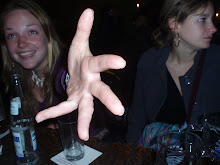
**This is the second in a series of posts in which various bloggers around Chile write on the same topic. The previous topic was Chilean men; the current one is Chilean women. Check out "Just Married Chilean Style" for links to the other blog posts.**
This topic was set for Friday. I've been dragging my feet about it because, frankly, there's a lot of animosity amongst gringas towards chilenas and I wasn't entirely sure if I wanted to participate in this topic. After thinking a bit, though, I do think I'd like to throw in my two cents on precisely that aspect of things.
Gringas in Chile tend to paint the following image of chilenas: catty, cloistered, competitive, fashion-challenged, and unfriendly. I don't agree, but I do understand where this perspective comes from, and why it's so universally held. I have had a few run-ins with the type of behavior that inspires this stereotype, and it can be excessive. In the incident that first comes to mind, I was at a bar with a chileno friend, two of his male friends, and their two girlfriends. We were all sitting around the table talking, and although the girls weren't being super friendly towards me, they were behaving pretty normally. Then the guys got up to get another round of drinks. Immediately, I became invisible. The girls pointedly stopped talking to me, to the point where they didn't respond when I tried to speak to them. When the guys reappeared, they went back to normal. It was the most outrageous thing that has happened to me in a social setting since puberty (and its accompanying insanity) passed. I bawled my eyes out about it when I got home that night. It was petty, it was mean, and it made me feel like I would never make friends in this country.
Incidents like this are the fuel for the anti-chilena machine. Are they ridiculous? Yes. Do they happen to me here more than at home? Yes. Are they the province of chilenas alone? No.
The thing is, chilenas are just like women everywhere in the sense that at their best, they are warm, caring, and nurturing. At their worst they are territorial and barbed towards other women. The problem is that as extranjeras, we gringas are more likely to encounter the latter behavior.
Why? Because women everywhere can be suspicious of other women. There are various situations and instances which make this more likely to happen, and the gringa-chilena relationship often stumbles onto a few of them.
The first factor, shall we call it, is that both men and women are often less open when they are with their closest friends. If I'm hanging around with my favorite people, you just don't seem as cool. Nor do I feel particularly obliged to hang out with you, because I'm already having a fine time. In Chile, this situation is far more likely to happen than in the United States, because people here are almost always in the company of their nearest and dearest. The itinerant, transitory north american lifestyle is just not the norm here. People do not move away from home for university; they are less likely to move to a new city for a job; they are more emotionally tied to their families and so tend to stay close; and they just plain don't have as many places to go. In the US, when we hit maturity there is the expectation that we will go out into the world and find our own unique place. This is facilitated by the fact that we can move to any one of dozens and dozens of cities, across an astonishingly large territory, without so much as getting a new form of identification. Here, the economy is very much centralized based on sector. Fishing? Head south. Mining? Head north. Office work? Santiago. All of these things combine to create a society where people grow up with the same friends throughout their lives. So when you meet a chilena, the people she is with most likely remember how she wore her hair as an eight year old. That's a lot of history to compete with; I hope you've got a good opening joke. Santaguinos (both men and women) who have moved to the coast have told me that they have the same problem breaking into friend circles.
The second factor is that both men and women are more threatened by people who are different from them. Period. Sad but true, worldwide. Ask any immigrant, anywhere. Add to this that Chile is known for its racism, isolationism, and distrust, and you have a culture that is going to be even less receptive towards outsiders. This is a cultural trait, but it is not restricted to the women.
The third is that foreigners take more work to hang out with. Cross-cultural friendships involve incorporating different perspectives on major issues, behaviors that may strike you as odd, different attitudes towards friendships, and a host of other complications. This is worth it a) if you are interested in international perspectives or b) if you are particularly interested in the person, or both. However, for a lot of people, I could see why it might just be easier to stick to people who think like you do, laugh at the same things, and have experienced similar things. It's not my style, but I understand it.
Finally, a lot of gringas in Chile are dating chilenos. Some came here for their chileno; some came alone and ended up involved in a relationship. This is normal, fun, and wonderful for those who have found love. However, this is factor number four. You will notice that the story I told about my own bad experience happened when I was in the company of a chileno. The thing is that women, in any culture, are far more likely to be awful to one another when there are men in the picture. This is something that I find incredibly sad about my gender, but it's not unique to Chile. We women are territorial about our male friends, about our boyfriends, about our brothers. When a new woman enters a mixed-gender group of friends, she is going to have a much harder time winning over the girls than the guys. They are going to want to know what her intentions are. They are going to make snap judgements about whether she is "worth" their friend's time. If they are single, they might see her as a threat or an interloper.
This is something that makes me incredibly sad every time that I see it. For instance, consider the classic example: a woman's boyfriend cheats on her. What does she do? She finds the other girl, calls her a slut, denounces her to everyone within earshot, cries a lot, forces her boyfriend to denounce the other girl as well, and then slowly rebuilds her relationship with him. The boyfriend is the one who broke a promise and a confidence, but he is absolved because the two women take it out on one another.
It's depressing, and it's a trait that we need to abandon as a gender if we ever want to fully rise to equality.
But is it something that chilenas have a monopoly on? No.
I'm not saying that it's easy to make friends with chilenas. This is a very closed society. However, it's not easy to make friends with chilenos, either. In six months I have been approached by far more chilenos than chilenas, sure. But they're not interested in being my friend, they want something from me. Specifically, either to become attached to my hip, or to take me home for the night. That hardly qualifies as friendly in my book. Meanwhile, the few chilenas who have made an effort towards me do so out of honest friendliness. With my Spanish, anyone who's willing to beast their way through a conversation with me with no specific benefit in mind has got to be a genuinely nice person.
Basically, this reminds me of something a professor told me when I lived in France. France, also, is a closed society, and my language classmates and I were complaining about not being able to make friends with the other students.
"I lived in the United States for one year," she said, roughly, "and at first I thought everyone was so nice. Everyone invited me out, took me places, talked to me...it was great. Except that was it. They weren't really my friends. It was all superficial. At the end of the year, after all of that, I had two real friends, people I could really count on. Here, no one will initiate a friendship with you like in the US. But when they do, it's because they mean it. So, at the end of the year, you'll probably have two friends, and they'll be real friends. It's a different style, but in the end, people are people, and you'll make connections with the same amount of people no matter where you live."
Showing posts with label communication. Show all posts
Showing posts with label communication. Show all posts
Monday, September 8, 2008


Thursday, August 28, 2008
Oh go ahead, say what you really think...
The mother of the family with which I live (a doozy of an English sentence....should it be "with whom?") ..has just come home.
She has been living with their eldest daughter for 2.5 months in order to take care of her granddaughter. Why? A terrible accident? A desperate job situation? No attachments back here in Valpo? No. It was winter. Therefore, the baby would die if taken from home to day care. You see this every day here. When babies are taken outside in the winter months, they are wrapped in fleece blankets so that not even one baby finger is sticking out. When my mother saw this for the first time last Saturday, she was quite concerned because she thought the bundled-baby-shape must have been on its way to the hospital. A few days later, we passed another fully wrapped baby...while both of us were wearing tank tops and sweating.
My German grandmother apparently had similar concerns when I was born. My birthday is in the beginning of August, and I was born in Boston, Massachusetts, USA. So the temperature on an average day in my first month of life was about 90 farenheit (high 30s celsius, I think, but anything with numbers loses me). However, my grandmother was extremely concerned about what was known as The Draft. My parents would find her lowering all the windows to a crack, because the dreadful draft was sure to suck away my life energy if I wasn't protected by being sealed in an airless room.
Anyhow. So Host Mom went to save the baby, in a manner after my maternal grandmother's own heart. I saw her today for the first time after her return a day ago. After berating me for my frequent absence from the house, she asked me: "How did you parents find you?"
That is a completely direct translation. You know what she means. However, think about it. We have no comparable question in English. I was rather confused when trying to respond in the immediate pace of a conversation. Did she mean, "were they happy to see you?" or "was it easy to meet them?" etc. Of course she wanted to know what they thought of me after 6 months (an obscene amount of time in this half of the Southern Cone). But really, what does one say? "They don't love me anymore"?
So I went with my steadfast, "Fine!" (en espanol...forgive my tilde-less keyboard)
And she responded, "Gordita?" ("a little fat?")
As a statement to my acclimatization, I was not entirely thrown off by this. When picturing seeing this woman again, I had thought perhaps she would comment on my Spanish (which gets better every month). "You speak so much better than when I left!" was a possible comment in my imagined world. I had not even really delved into the past tense when she left. I had a vague notion that she might get onto less positive subjects, given the cultural tendency towards the utterly blunt, but I was still rather put off (despite understanding its normalcy) by the weight comment.
This is impossible for a gringa to talk about without falling into either exxageration or dimunition, but to try to be fair, I would say I've gained about 10 pounds in Chile (due mostly to the incredibly unbalanced diet, which will be featured in another post). However, due to the fact that I'm constantly exercising by walking up and down hils, my body in general form hasn't changed too drastically. It's me, plus a widening here or there. I'm not all that interested in any of it, given its small proportions, but at the same time it's not exactly something I'm thrilled about. Being a Northamerican woman, I am pretty well conditioned to think that any change in my body is something to worry over. I don't endorse it, but there it is.
However, I went with the flow. "Yes, a little, I guess," I said.
"Yeah," she said, nodding, "You're definitely fatter than when I left."
Thanks!
From there we moved on to my parents being tired from so much walking, which was attributed to them probably being lazy and used to driving everywhere. Finally we rounded off the reunion with yet another chat about whether or not my volunteer program was going to pay them more rent.
It was truly heartwarming. Honesty is certainly not lacking in our relationship, I can say that.
On a totally and completely unrelated note, I am apartment hunting at the moment...
Yes. It's time to be an isolated, antisocial gringa adult once more.
She has been living with their eldest daughter for 2.5 months in order to take care of her granddaughter. Why? A terrible accident? A desperate job situation? No attachments back here in Valpo? No. It was winter. Therefore, the baby would die if taken from home to day care. You see this every day here. When babies are taken outside in the winter months, they are wrapped in fleece blankets so that not even one baby finger is sticking out. When my mother saw this for the first time last Saturday, she was quite concerned because she thought the bundled-baby-shape must have been on its way to the hospital. A few days later, we passed another fully wrapped baby...while both of us were wearing tank tops and sweating.
My German grandmother apparently had similar concerns when I was born. My birthday is in the beginning of August, and I was born in Boston, Massachusetts, USA. So the temperature on an average day in my first month of life was about 90 farenheit (high 30s celsius, I think, but anything with numbers loses me). However, my grandmother was extremely concerned about what was known as The Draft. My parents would find her lowering all the windows to a crack, because the dreadful draft was sure to suck away my life energy if I wasn't protected by being sealed in an airless room.
Anyhow. So Host Mom went to save the baby, in a manner after my maternal grandmother's own heart. I saw her today for the first time after her return a day ago. After berating me for my frequent absence from the house, she asked me: "How did you parents find you?"
That is a completely direct translation. You know what she means. However, think about it. We have no comparable question in English. I was rather confused when trying to respond in the immediate pace of a conversation. Did she mean, "were they happy to see you?" or "was it easy to meet them?" etc. Of course she wanted to know what they thought of me after 6 months (an obscene amount of time in this half of the Southern Cone). But really, what does one say? "They don't love me anymore"?
So I went with my steadfast, "Fine!" (en espanol...forgive my tilde-less keyboard)
And she responded, "Gordita?" ("a little fat?")
As a statement to my acclimatization, I was not entirely thrown off by this. When picturing seeing this woman again, I had thought perhaps she would comment on my Spanish (which gets better every month). "You speak so much better than when I left!" was a possible comment in my imagined world. I had not even really delved into the past tense when she left. I had a vague notion that she might get onto less positive subjects, given the cultural tendency towards the utterly blunt, but I was still rather put off (despite understanding its normalcy) by the weight comment.
This is impossible for a gringa to talk about without falling into either exxageration or dimunition, but to try to be fair, I would say I've gained about 10 pounds in Chile (due mostly to the incredibly unbalanced diet, which will be featured in another post). However, due to the fact that I'm constantly exercising by walking up and down hils, my body in general form hasn't changed too drastically. It's me, plus a widening here or there. I'm not all that interested in any of it, given its small proportions, but at the same time it's not exactly something I'm thrilled about. Being a Northamerican woman, I am pretty well conditioned to think that any change in my body is something to worry over. I don't endorse it, but there it is.
However, I went with the flow. "Yes, a little, I guess," I said.
"Yeah," she said, nodding, "You're definitely fatter than when I left."
Thanks!
From there we moved on to my parents being tired from so much walking, which was attributed to them probably being lazy and used to driving everywhere. Finally we rounded off the reunion with yet another chat about whether or not my volunteer program was going to pay them more rent.
It was truly heartwarming. Honesty is certainly not lacking in our relationship, I can say that.
On a totally and completely unrelated note, I am apartment hunting at the moment...
Yes. It's time to be an isolated, antisocial gringa adult once more.
Monday, August 11, 2008
Awkward: the most gringo word on earth.
This, anyhow, is what I have concluded after months of searching for a translation for this word. On a much earlier post, I asked for ideas. Some people suggested incomodo, or "uncomfortable," but my bilingual Argentinian friend nixed this. I also agree in my limited understanding that it doesn't fit the bill. So ever since I've been pursuing a translation on and off.
Why? Well, because living in Chile is the singular most awkward experience of my life. Showing up in an isolated, Spanish-speaking country where people both do not tend to speak English and are also somewhat wary and insulated from foreigners, without any Spanish whatsoever: every day since February 7, 2008, has been a succession of awkward events. Add in trying to make new friends, learn a new profession, live with somebody else's family, and navigate a new city, and you have a host of extra (as if that were necessary) awkward moments.
As such, it's been rather frusturating to me that I am unable to express this word in Spanish. Given that I live with Chileans and also do my best to befriend others (with pretty unsatisfactory results up to this point, unfortunately) I would like to be able to describe my day accurately.
I've finally figured out why the search for this word has proved so difficult. The reason: awkward is an invention of gringos. The concept does not exist in latin culture.
I've discovered this through a series of interviews with Chileans in which I explain awkward scenarios to them in an effort to elicit the word one would use to describe them. In every instance, the Chilean in question has looked at me as if to say...."So?" Well, actually, they've said the Spanish equivalent. Consider the following example (in which I am portraying myself as far more articulate than I actually am in this language):
"So you're at a dinner party," I suggested to my host sister. "All of a sudden a guy says something kind of mean and personal about his girlfriend. So everyone gets kind of quiet and tries to pretend that they didn't hear what happened."
I looked at her expectantly. "No," she said, "if it's not too bad, then it's funny. And if the guy is out of line, then you'd be like, 'What are you saying to her?! Back off!'"
I tried again. "Sometimes it can be sort of an endearing quality. Like a friend who always says the wrong thing at the wrong time."
"Like acting autistic?" she asked. (Disclaimer: Translation! Don't blame me for lack of PCness, I'm writing about Chile here).
"No, no, not like that, just someone who always comes out with odd things or things that kind of don't fit or shouldn't be said right then, but it's kind of funny because of that."
"So it's someone who's got a good sense of humor," she said.
This is only a sampler. I've had quite a few conversations like this (and this particular one extended a good deal longer).
There are no awkward silences, it seems, because either everyone is talking at once or no one is talking because they have no interest in talking. End of story.
There are no awkward foot-in-mouth moments, because no one is going to pretend they didn't hear what you said. You're just plain in trouble, that's all.
There are no awkward people, because what we would consider awkwardness is either a sense of humor or social backwardness.
When I think about this subject I get a split screen image in my head of my dinner party scenario: on the left, 6 people with tea nervously avoiding eye contact with one another, rattling cutlery and making pointless cover-up small talk. Perhaps also some throat-clearing, and maybe the hostess might hustle the girlfriend off into the kitchen and shoot a silent reproachful look at the offender on their return. On the right: six Chileans yelling at one another with many of those long intonations that swoop from the gutteral up into the highest registers of the human voice (frequently heard in "nooooooooo, meeeentiiiiiirrraaaaaa"); with the women scolding the men in defense of the scorned girlfriend and the men raucously defending their friend's right to free speech.
So far I have managed to come upon one situation which can possibly be awkward: when riding in ascensores, people are unsure whether or not to say hello to everyone--because it's very small, but it is still public transportation. You would say hello to everyone in a small room--but not everyone on a micro. Still, nonetheless, my host sister at least does not find this to be "awkward" in the sense that I would if I were coming from her cultural perspective (of course I don't say hi to anyone, and I find that normal, but I'm an icy gringa). She just thinks it's funny that half the people say hi and half don't.
So, fellow gringos, if you find yourself in awkward scenarios and wish to explain this to the latins in your life, I suggest you do what I did: after careful explanations lasting a good half an hour, my host family now understands the word "awkward," at least in the sense that it pertains somehow to gringos becoming nervous when dealing with social situations (they call me autistic, too). Nonetheless, at least in my house, "awkward" has now been adopted into the pantheon of Chilean modismos.
Why? Well, because living in Chile is the singular most awkward experience of my life. Showing up in an isolated, Spanish-speaking country where people both do not tend to speak English and are also somewhat wary and insulated from foreigners, without any Spanish whatsoever: every day since February 7, 2008, has been a succession of awkward events. Add in trying to make new friends, learn a new profession, live with somebody else's family, and navigate a new city, and you have a host of extra (as if that were necessary) awkward moments.
As such, it's been rather frusturating to me that I am unable to express this word in Spanish. Given that I live with Chileans and also do my best to befriend others (with pretty unsatisfactory results up to this point, unfortunately) I would like to be able to describe my day accurately.
I've finally figured out why the search for this word has proved so difficult. The reason: awkward is an invention of gringos. The concept does not exist in latin culture.
I've discovered this through a series of interviews with Chileans in which I explain awkward scenarios to them in an effort to elicit the word one would use to describe them. In every instance, the Chilean in question has looked at me as if to say...."So?" Well, actually, they've said the Spanish equivalent. Consider the following example (in which I am portraying myself as far more articulate than I actually am in this language):
"So you're at a dinner party," I suggested to my host sister. "All of a sudden a guy says something kind of mean and personal about his girlfriend. So everyone gets kind of quiet and tries to pretend that they didn't hear what happened."
I looked at her expectantly. "No," she said, "if it's not too bad, then it's funny. And if the guy is out of line, then you'd be like, 'What are you saying to her?! Back off!'"
I tried again. "Sometimes it can be sort of an endearing quality. Like a friend who always says the wrong thing at the wrong time."
"Like acting autistic?" she asked. (Disclaimer: Translation! Don't blame me for lack of PCness, I'm writing about Chile here).
"No, no, not like that, just someone who always comes out with odd things or things that kind of don't fit or shouldn't be said right then, but it's kind of funny because of that."
"So it's someone who's got a good sense of humor," she said.
This is only a sampler. I've had quite a few conversations like this (and this particular one extended a good deal longer).
There are no awkward silences, it seems, because either everyone is talking at once or no one is talking because they have no interest in talking. End of story.
There are no awkward foot-in-mouth moments, because no one is going to pretend they didn't hear what you said. You're just plain in trouble, that's all.
There are no awkward people, because what we would consider awkwardness is either a sense of humor or social backwardness.
When I think about this subject I get a split screen image in my head of my dinner party scenario: on the left, 6 people with tea nervously avoiding eye contact with one another, rattling cutlery and making pointless cover-up small talk. Perhaps also some throat-clearing, and maybe the hostess might hustle the girlfriend off into the kitchen and shoot a silent reproachful look at the offender on their return. On the right: six Chileans yelling at one another with many of those long intonations that swoop from the gutteral up into the highest registers of the human voice (frequently heard in "nooooooooo, meeeentiiiiiirrraaaaaa"); with the women scolding the men in defense of the scorned girlfriend and the men raucously defending their friend's right to free speech.
So far I have managed to come upon one situation which can possibly be awkward: when riding in ascensores, people are unsure whether or not to say hello to everyone--because it's very small, but it is still public transportation. You would say hello to everyone in a small room--but not everyone on a micro. Still, nonetheless, my host sister at least does not find this to be "awkward" in the sense that I would if I were coming from her cultural perspective (of course I don't say hi to anyone, and I find that normal, but I'm an icy gringa). She just thinks it's funny that half the people say hi and half don't.
So, fellow gringos, if you find yourself in awkward scenarios and wish to explain this to the latins in your life, I suggest you do what I did: after careful explanations lasting a good half an hour, my host family now understands the word "awkward," at least in the sense that it pertains somehow to gringos becoming nervous when dealing with social situations (they call me autistic, too). Nonetheless, at least in my house, "awkward" has now been adopted into the pantheon of Chilean modismos.
Friday, July 18, 2008
Language barrier: a two-way street
Tomorrow, unless I get stood up (a rather common occurence when befriending Chileans, unfortunately), I am meant to go hiking at a national park a bit east of the city.
I was curious about what I'm in for, since the only hiking I've done recently is up the hill to my house, and all in all I've been pretty much a computer-bound, workaholic slug as of late.
I browsed a bunch of websites that seem to agree that I'm in trouble, as this is an actual mountain of sorts that I'm dealing with. However, I found one description of the park that had this excellent itemization of possible activities:
Hiking, high mountain tours, climbing, picnic, photography, bird watch, flora and fauna contemplation.
So, maybe I'll let my compañero do the high mountain tour while I stay at the bottom for a bit of flora and fauna contemplation.
I was curious about what I'm in for, since the only hiking I've done recently is up the hill to my house, and all in all I've been pretty much a computer-bound, workaholic slug as of late.
I browsed a bunch of websites that seem to agree that I'm in trouble, as this is an actual mountain of sorts that I'm dealing with. However, I found one description of the park that had this excellent itemization of possible activities:
Hiking, high mountain tours, climbing, picnic, photography, bird watch, flora and fauna contemplation.
So, maybe I'll let my compañero do the high mountain tour while I stay at the bottom for a bit of flora and fauna contemplation.
Subscribe to:
Posts (Atom)